|
 |
 |
 |
 |
 |
 |
 |
 |

 |
Indonesian Mud Volcano Caused By Drilling
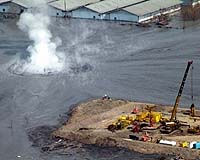
Paris (AFP) Jan 23, 2007 A mud volcano that has erupted in Indonesia, forcing the evacuation of thousands of villagers, was most probably caused by drilling for gas, according to the first published scientific study into the phenomenon. The eruption "appears to have been triggered by drilling of overpressured porous and permeable limestones at depth of around 2,830 metres (7,735 feet) below the surface," says the study, conducted by British experts and published in a US journal. It adds that the volcano has been disgorging between 7,000 and 150,000 cubic metres (245,000 and 5.25 million cubic feet) of mud every day. Such pressures, coupled to the local geology, suggest the flow "will continue for many months and possibly years to come," it warns. In the coming months, sag-like subsidence several kilometers (miles) wide will occur, and around the main vent there is likely to be "more dramatic collapse," forming a crater, it adds. An area of at least 10 square kilometers (3.9 square miles) around the volcano will be uninhabitable for years, and over 11,000 people will be permanently displaced, it says. The research is conducted by a team led by Richard Davies, a professor at the University of Durham's Centre for Research into Earth Energy Systems in northeastern England. It appears in the February issue of GSA Today, a peer-assessed journal of the Geological Society of America (GSA). The volcano, known locally as "Lusi," has been spewing steaming mud since May 29 last year, submerging four villages, fields and factories. It erupted from a gas well near Surabaya, East Java, that was operated by Lapindo Brantas Inc. As many as 13,000 people have fled their homes. The British experts analysed satellite images of the area to make their study. They say that seepage of mud and water are usually a preventable hazard when exploring for oil and gas. "It is standard industry procedure that this kind of drilling requires the use of steel casing to support the borehole, to protect against the pressure of fluids such as water, oil or gas," Davies said in a press release. "In the case of Lusi, a pressured limestone rock containing water -- a water aquifer -- was drilled while the lower part of the borehole was exposed and not protected by casing. "As a result, rocks fractured and a mix of mud and water worked its way to the surface. Our research brings us to the conclusion that the incident was most probably the result of drilling." Davies said the case in Indonesia was similar to a blowout that happened offshore of Brunei in 1979. "Just as is most probably the case with Lusi, the Brunei event was caused by drilling and it took an international oil company almost 30 years and 20 relief wells and monitoring before the eruption stopped," he added. Last week, Indonesia's coordinating minister for social welfare, Aburizal Bakrie, whose family firm controls Lapindo Brantas, said the volcano was a "natural disaster" unrelated to the drilling activities. "It is not because of the Lapindo drill case but it is because of the quake," he said, referring to a May 27 temblor near the ancient city of Yogyakarta that killed around 6,000 people. But this scenario is ruled out by the study. It concludes that the quake was not to blame, mainly because two days elapsed before mud volcano erupted, and no other mud volcanoes occurred in the region after the temblor. President Susilo Bambang Yudhoyono last month ordered Lapindo to pay 3.8 trillion rupiah (420.7 million dollars) in compensation and costs related to the mud flow.
Source: Agence France-Presse Community Email This Article Comment On This Article Related Links Bring Order To A World Of Disasters When the Earth Quakes Powering The World in the 21st Century at Energy-Daily.com Bringing Order To A World Of Disasters A world of storm and tempest When the Earth Quakes
 FTMSC Signs Partnership With Telecoms Sans Frontieres
 Geneva (SPX) Jan 24, 2007
France Telecom Mobile Satellite Communications (FTMSC) and Telecoms Sans Frontieres (TSF) have signed a partnership for the development of emergency mobile satellite communications solutions. The two companies announced the news at International Aid and Trade, a trade show dedicated to humanitarian aid, relief and development in Geneva from 24-25 January 2007. |
|
|

| The content herein, unless otherwise known to be public domain, are Copyright 1995-2006 - SpaceDaily.AFP and UPI Wire Stories are copyright Agence France-Presse and United Press International. ESA PortalReports are copyright European Space Agency. All NASA sourced material is public domain. Additionalcopyrights may apply in whole or part to other bona fide parties. Advertising does not imply endorsement,agreement or approval of any opinions, statements or information provided by SpaceDaily on any Web page published or hosted by SpaceDaily. Privacy Statement |