|
 |
 |
 |
 |
 |
 |
 |
 |

 |
Indonesia To Use Concrete Balls To Plug "Mud Volcano"
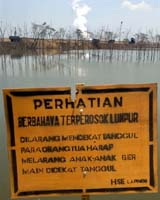
Jakarta (AFP) Feb 20, 2007 Hundreds of concrete balls will be dropped into a "mud volcano" on Wednesday, although experts warned it is unlikely to stop a massive mud flow which has swallowed villages and left 15,000 people homeless. Officials said the concrete balls would be lowered by crane into the main source of the mud spill near Surabaya, in East Java. "Preparations are just about done," Rudi Novrianto, spokesman for the government team handling the crisis, told AFP Tuesday. "We hope the balls can slow down the flow by between 50 and 70 percent," said Novrianto. A gas well near Surabaya, operated by PT Lapindo Brantas, has spewed steaming mud since May last year, submerging villages, factories and fields. The advancing sea of mud is now threatening to swamp a key railway, which is to be rerouted away from the danger zone. Antara news agency reported 2,000 of the high-density concrete balls had been ordered from the Bandung Institute of Technology, after its physics experts came up with the plan to stem the mudflow. Various ideas on how to stop the flow and divert the mud into a nearby river have been tried, but none were successful. The latest effort was originally planned for two weeks ago, but was delayed for technical reasons. However geologist Edi Sunardi, from the University of Pajajaran, said "the effort is useless. It will not solve the problem". "They assume that the flow comes from a hole, but we're looking at a plane, and you cannot plug such a plane with concrete balls," said Sunardi, explaining that the strong pressure may even push the balls back up to the surface. He said the only option was to quickly channel the mud to the sea before it dried out. Top welfare minister Aburizal Bakrie claimed last month that the flow was a "natural disaster" unrelated to the drilling activities of Lapindo, which belongs to a group controlled by his family. However, a study by British experts said the eruption was most likely caused by drilling for gas. President Susilo Bambang Yudhoyono has already ordered Lapindo to pay 3.8 trillion rupiah (420 million dollars) in compensation and costs related to the disaster.
Source: Agence France-Presse Community Email This Article Comment On This Article Related Links Bring Order To A World Of Disasters Bringing Order To A World Of Disasters A world of storm and tempest When the Earth Quakes
 Sending Out An SOS Russian Satellites Come To The Rescue
 Moscow (RIA Novosti) Feb 21, 2007
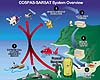
Thirty years ago the Soviet government issued a resolution on setting up a space-based system to search for ships in distress (known by its initials in Russian, KOSPAS) anywhere in the world. The quick location of such ships reduced by nearly tenfold the time of rescue operations in comparison with the usual methods and also reduced the risk of accidents involving rescue ships and aircraft themselves. |
|
|

| The content herein, unless otherwise known to be public domain, are Copyright 1995-2006 - SpaceDaily.AFP and UPI Wire Stories are copyright Agence France-Presse and United Press International. ESA PortalReports are copyright European Space Agency. All NASA sourced material is public domain. Additionalcopyrights may apply in whole or part to other bona fide parties. Advertising does not imply endorsement,agreement or approval of any opinions, statements or information provided by SpaceDaily on any Web page published or hosted by SpaceDaily. Privacy Statement |