|
 |
 |
 |
 |
 |
 |
 |
 |

 |
India's lithospheric roots are studied
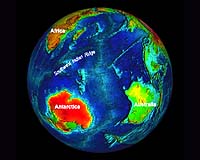
Hyderabad, India (UPI) Oct 22, 2007 The Indian sub-continent collided with the enormous Eurasian continent 50 million years ago with enough force to create the Himalayan Mountains. Scientists from the National Geophysical Research Institute in Hyderabad, India, and Germany's National Laboratory for Geosciences determined that with a velocity of about 20 centimeters a year, India was the fastest of the former parts of Gondwanaland. Until 140 million years ago, India was part of the supercontinent Gondwanaland. When Gondwanaland broke up, its various parts drifted with different velocities. Today those various parts constitute India, Africa, Australia, Antarctica and South America. While India's lithospheric plate is only about 62 miles thick, the other parts of Gondwanaland are about 125 miles thick. The scientists posit the reason for the break up of Gondwanaland was a mantle plume that heated the supercontinent from below, thereby causing it to break. That plume, said the scientists, might have melted the lower part of the Indian sub-continent, thus allowing India to move faster and further than the other parts. The study appears in the Oct. 18 issue of the journal Nature. Community Email This Article Comment On This Article Related Links Tectonic Science and News
 The Fastest Continent
 Bonn, Germany (SPX) Oct 18, 2007
50 million years ago the Indian sub-continent collided with the enormous Eurasian continent with a velocity of about 20 cm/year. With such a high velocity India was the fastest of the former parts of Gondwanaland, according to a report by a team of scientists from the GeoForschungsZentrum Potsdam (GFZ, Germany's National Lab for Geosciences) and the National Geophysical Research Institute, India, in the 18th October 2007 edition of the Science Magazine "Nature". Due to this collision at such high velocities the largest mountain belt on Earth, the Himalayas, was formed, as was the massive Tibetanplateau. |
|
|

| The content herein, unless otherwise known to be public domain, are Copyright 1995-2007 - SpaceDaily.AFP and UPI Wire Stories are copyright Agence France-Presse and United Press International. ESA Portal Reports are copyright European Space Agency. All NASA sourced material is public domain. Additional copyrights may apply in whole or part to other bona fide parties. Advertising does not imply endorsement,agreement or approval of any opinions, statements or information provided by SpaceDaily on any Web page published or hosted by SpaceDaily. Privacy Statement |