|
 |
 |
 |
 |
 |
 |
 |
 |

 |
India's GSAT-1 Fell Short of Geostationary Orbit
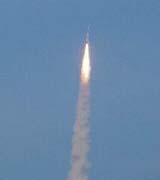
Bangalore - May 1, 2001 The first developmental flight of Geo-synchronous Satellite Launch Vehicle, GSLV-D1, was successfully carried out on April 18, 2001 from SHAR Centre, Sriharikota. The flight was primarily intended to validate the vehicle design and evaluate flight performance parameters. This objective was met when the experimental satellite, GSAT-1, was successfully placed in the geo-synchronous transfer orbit as planned. For the first time, validation of Geo-synchronous launch Mission from SHAR with associated acquisition of signals at satellite injection and carrying out the orbit raising maneuvers through a network of international stations, coordinated and controlled by INSAT Master Control Facility, Hassan, has been achieved. The preliminary analysis of the flight data indicates that GSLV has performed well in flight validating the design and functioning of all the vehicle subsystems in flight, the integration procedures including the safe handling of large quantities of liquid and cryogenic propellants, the navigation and control, the flight sequence like ignition of various stages, separation of spent stages, the heatshield and the spacecraft, besides the coordinated working of a network of ground stations to track and monitor the vehicle in flight. It may be recalled that the first attempt to launch GSLV on March 28, 2001 was aborted one second before the lift-off by the Automatic Launch Processing System (ALS) after it detected that one of the liquid propulsion strap-on boosters did not develop the required thrust. Based on the detailed analysis of the data during the first three seconds of operation of the four strap-on motors, it was established that the reason for one of the strap-on boosters not developing the required thrust was due to a defective plumbing in the oxidiser flow line of the engine, which had escaped detection during testing. This resulted in reduced flow of oxidiser to the engine. The anomalous engine was replaced with a standby engine for the relaunch on April 18, 2001. The successful flight of GSLV-D1 has validated the analysis and the solution adopted for the relaunch. The GSLV flight test opportunity was also used to place an experimental satellite, GSAT-1, in the geo-stationary orbit to prove new spacecraft elements and conduct a few communication experiments. GSAT-1 was placed in an orbit of 181 km perigee (nearest point to earth) and 32,051 km apogee (farthest point to earth) with an inclination of 19.2 degree with respect to equatorial plane. The satellite was injected with a velocity that was 99.4 percent of the intended 10.2 kilometre per second. But this minor shortfall of 0.6 % in the overall velocity resulted in reduction of orbital apogee of the satellite. The perigee of 181 km and inclination of 19.2 deg were close to targeted values. This minor deficiency in the apogee altitude was correctable and, in fact, was corrected during the orbit manoeuvres of the satellite since such contingencies are provided for in the mission planning.
All deployments operations like those of antenna reflector, solar array and the solar sail have been successfully completed. Further, the satellite has been put in 3-axis stabilisation mode using momentum wheels.
Several new communication satellite technologies have been evaluated using GSAT-1. These include:
During the orbit raising operations of the satellite, consumption of propellant was much more than planned resulting in a shortage of about 10 kg to achieve the geo-stationary orbit. The satellite is presently in a drift orbit with an orbital period of 23 hr 2 minutes. In conclusion, (i) GSLV-D1 launch vehicle has fulfilled all its intended objectives and injected the GSAT-1 spacecraft into the Geo-synchronous transfer orbit (ii) the shortfall of 0.6% in final velocity of injection was correctable and was corrected using satellite propulsion (iii) several new technologies for the spacecraft have already been evaluated. The satellite will be kept under observation for further operations. Community Email This Article Comment On This Article Related Links Indian Space Research Organisation SpaceDaily Search SpaceDaily Subscribe To SpaceDaily Express The latest information about the Commercial Satellite Industry
 Orbcomm's Equity Financings Complete
 Bremen, Germany (SPX) Jan 06, 2006
OHB Technology affiliated company Orbcomm has announced that it has completed equity financings totaling over $110 million led by Pacific Corporate Group (PCG), which committed $60 million. New investors, in addition to PCG, include investment firms MH Equity Investors and Torch Hill Capital. |
|
|

|
|
|
|
|
|
|
|
|
|
|
|
| The content herein, unless otherwise known to be public domain, are Copyright 1995-2006 - SpaceDaily.AFP and UPI Wire Stories are copyright Agence France-Presse and United Press International. ESA PortalReports are copyright European Space Agency. All NASA sourced material is public domain. Additionalcopyrights may apply in whole or part to other bona fide parties. Advertising does not imply endorsement,agreement or approval of any opinions, statements or information provided by SpaceDaily on any Web page published or hosted by SpaceDaily. Privacy Statement |