|
 |
 |
 |
 |
 |
 |
 |
 |

 |
Indian Ocean Climate Watch Network Grows
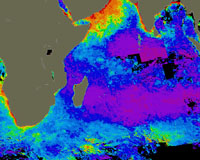
Perth WA (SPX) Apr 04, 2005 The development of a huge observing network to monitor ocean currents and temperature and understand the conditions that bring rain - and drought - to nearly two thirds of the world's population is underway in the Indian Ocean. The development of a huge observing network to monitor ocean currents and temperature and understand the conditions that bring rain - and drought - to nearly two thirds of the world's population is underway in the Indian Ocean. "This is a significant initiative that will be as relevant and important to the wheat farmers of Western Australia as it will be to rice growers in India or Indonesia," says Dr Gary Meyers, from CSIRO's Wealth from Oceans Flagship. Nine deep ocean moorings are already in place through investment by the United States, Japan and India, and a further mooring is being considered in a joint arrangement between Australia and China. One of the architects of a system he and other scientists in the region have been advocating for more than two decades, Dr Meyers hosted the international Indian Ocean Panel at a coordination and planning meeting in Hobart this week involving climate scientists from eight countries. The Indian Ocean Panel is a permanent body jointly sponsored by the World Climate Research Program's CLIVAR project on forecasting, and the Intergovernmental Oceanographic Commission's Global Ocean Observing System. The climate network shares some common elements with an Indian Ocean basin warning system for tsunami and other marine hazards such as tropical cyclones and storm surge, all three natural events that have in the past caused great damage to the peoples living on the rim of the Indian Ocean. Dr Meyers said the recent discovery of El Nino-like phenomena in the Indian Ocean - strong two-way interactions between ocean and atmosphere - has highlighted the importance of regional data collection to understand and predict seasonal and longer-term climate variability over all the surrounding continents. Among these are:
Dr Meyers said Australian science has considerable experience in ocean monitoring through its present involvement in international research programs. It has initiated a regional ocean watch system using commercial shipping to monitor subsurface ocean temperature, built a network of tide gauges in the Pacific, and piloted the Argo ocean profiling program between in the eastern Indian and Southern Oceans. Since last December, deployed $1 million worth of moored instruments in the Indonesian archipelago in a five-nation project monitoring the system of ocean currents draining the Pacific into the Indian Ocean. "Elements of a basin-wide observing network are already in place and generating valuable ocean data. Through satellites, US and Japanese scientists are obtaining information from some of the moorings within 24 hours of recordings, and making the data available to climate modelling and prediction centres around the world. "Our intention is to build on this foundation and expand it to improve our understanding of temperature structure and currents across the North and South Indian Oceans," he said. In the mid-1980's an array of instruments was deployed in the tropical Pacific Ocean with the intent of detecting the onset of El Nino-La Nina events and by the mid-1990's it was providing valuable advance notice to climatologists and Governments of potentially wet or dry seasons ahead. Community Email This Article Comment On This Article Related Links CSIRO Bureau of Meteorology SpaceDaily Search SpaceDaily Subscribe To SpaceDaily Express Earth Observation News - Suppiliers, Technology and Application
 New Legislation Initiated To Support Commercial Remote Sensing Industry
 New York NY (SPX) Jan 11, 2006
The importance of remotely sensed data and technologies to support natural disasters has prompted attention and action in Washington. New initiatives and legislation authorizing appropriations to the remote sensing industry will be discussed at Strategic Research Institute's U.S. Commercial Remote Sensing Industry conference, scheduled for February 9-10, 2006 in Washington D.C. |
|
|

| The content herein, unless otherwise known to be public domain, are Copyright 1995-2006 - SpaceDaily.AFP and UPI Wire Stories are copyright Agence France-Presse and United Press International. ESA PortalReports are copyright European Space Agency. All NASA sourced material is public domain. Additionalcopyrights may apply in whole or part to other bona fide parties. Advertising does not imply endorsement,agreement or approval of any opinions, statements or information provided by SpaceDaily on any Web page published or hosted by SpaceDaily. Privacy Statement |