|
 |
 |
 |
 |
 |
 |
 |
 |

 |
Indian Eddies Supply Atlantic Ocean With Warm Water
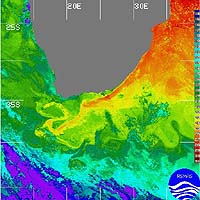
Cape Town, South Africa (SPX) Oct 11, 2005 Water from the Indian Ocean does not reach the South Atlantic Ocean continuously, but in separate packages. These are called Agulhas eddies, after the current along the east coast of Southern Africa where they originate from. Dutch researcher Astrid van Veldhoven characterised the fate of these rapidly rotating, three hundred kilometre wide and five kilometres deep, warm eddies during their journey to the Atlantic Ocean. Over the past four years, the Royal Netherlands Institute for Sea Research (NIOZ) on Texel, in partnership with Utrecht University and the University of Cape Town, has carried out a large NWO-funded project into the Agulhas eddies, which transport seawater from the Indian Ocean to the South Atlantic Ocean. During this project the NIOZ research vessel 'Pelagia' and the University of Cape Town's research vessel 'Agulhas' were remotely navigated by the Utrecht researchers, who interpreted satellite images from behind their computers. Satellite images revealed that the warm Agulhas eddies rose up as small hills above the Atlantic Ocean with a maximum height of about one metre. Moreover, Van Veldhoven visited the eddies on three occasions onboard the research vessel. The Agulhas eddies turned out to be large warm rings of water from the Indian Ocean with a diameter of about 300 kilometres within which the water sometimes rotated at a speed of more than 3.6 kilometres per hour in an anticlockwise direction. To everyone's surprise the eddy was found to stretch from the ocean surface right down to the ocean floor at a depth of some five kilometres; it therefore has a volume of about 350,000 cubic kilometres. On the ocean surface, young eddies are at most 5 degrees Celsius warmer than the surrounding Atlantic Ocean. Due to their enormous volume, the eddies import considerable quantities of heat into the Atlantic Ocean. Van Veldhoven carried out a detailed study of how these enormous eddies transformed, rotated increasingly slowly, and as a result of this gradually released their heat and salt into the surrounding cold Atlantic Ocean and into the atmosphere. The eddies only completely subside when they are halfway to South America. The knowledge acquired from this research will be used to improve computer models of the global ocean circulation. Such models are necessary for improved predictions of climate change and the degree of global warming due to the greenhouse effect. Astrid van Veldhoven's research was funded by NWO. Community Email This Article Comment On This Article Related Links SpaceDaily Search SpaceDaily Subscribe To SpaceDaily Express Water News - Science, Technology and Politics
 China To Improve Water Supply
 Beijing (XNA) Dec 18, 2005
Chinese Vice Premier Hui Liangyu said Saturday China will speed up construction of water supply projects, while giving priority to water conservancy for sustainable use of water resources in the coming year. |
|
|

| The content herein, unless otherwise known to be public domain, are Copyright 1995-2006 - SpaceDaily.AFP and UPI Wire Stories are copyright Agence France-Presse and United Press International. ESA PortalReports are copyright European Space Agency. All NASA sourced material is public domain. Additionalcopyrights may apply in whole or part to other bona fide parties. Advertising does not imply endorsement,agreement or approval of any opinions, statements or information provided by SpaceDaily on any Web page published or hosted by SpaceDaily. Privacy Statement |