|
 |
 |
 |
 |
 |
 |
 |
 |

 |
India Tests Technology For Space Vehicles
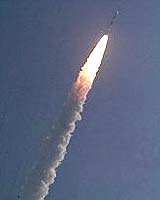
New Delhi, India (VOA) Jan 10, 2007 India has launched a satellite designed to test re-entry technology that could be used to prepare for a future manned mission. As Anjana Pasricha reports from New Delhi, the experiment is the first step toward a more ambitious foray into space. A red and white rocket blasted off Wednesday from Sriharikota in the southern state of Andhra Pradesh carrying four payloads: an Indian remote sensing satellite, two foreign-built satellites and a satellite designed to test technology for space vehicles re-entering the atmosphere when they return to earth. The head of the Indian Space Research Organization, G. Madhavan Nair, said on national television the satellites were successfully placed in orbit. "It is a great day for the country," he said. "We have done it, we have done it precisely, we have put all the four spacecraft into the orbit. I think I have no other words than to say it is a textbook mission." For Indian scientists, the main focus of Wednesday's launch is on the 550-kilogram capsule that will help them test re-entry technology for the first time. The capsule is designed to orbit the earth for 13 to 30 days before plunging into the Bay of Bengal, where it will be recovered. The Indian Space Research Organization says this capsule will test technology for "navigation, guidance and control during the re-entry phase." Only a handful of countries possess re-entry technology, which is a needed for sending manned missions into space. A spokesman for the Indian space agency, S. Krishnamurthy, says this experiment will give India crucial technology for more ambitious missions. "These are some of the technologies which of course will be useful for the future for whatever we do, whether it is manned or even to send this type of capsule, carry some experiment, do it in space, and recover those experiments after some time," he said. India has not announced plans for a manned space mission, but the country's scientists have shown growing interest in space exploration. They plan to send an unmanned spacecraft to the moon in the next three years. Scientists hope this mission will be the first step in India's voyage to other planets. For decades, India's space program has focused on providing services such as telecommunications and weather forecasting. In recent years, the program has also developed vehicles that can put smaller satellites into space. Officials say Wednesday's launch recaptured the space program's confidence. Last July an attempt to launch a communications satellite failed. Community Email This Article Comment On This Article Related Links ISRO CARTOSAT-2 Space capsule Recovery Experiment (SRE-1) LAPAN-TUBSAT and PEHUENSAT-1 Launch Pad at Space-Travel.com Launch Pad at Space-Travel.com
 Arianespace To Launch ProtoStar I
 Paris, France (SPX) Jan 09, 2007
Arianespace CEO Jean-Yves Le Gall has announced during his annual January press conference that Arianespace will launch the ProtoStar I satellite for ProtoStar. This is the 280th launch contract won by Arianespace since its inception in March 1980. ProtoStar I will be placed into geostationary transfer orbit by an Ariane 5 from the Guiana Space Center, Europe's Spaceport in Kourou, French Guiana, during the first half of 2008. |
|
|

| The content herein, unless otherwise known to be public domain, are Copyright 1995-2006 - SpaceDaily.AFP and UPI Wire Stories are copyright Agence France-Presse and United Press International. ESA PortalReports are copyright European Space Agency. All NASA sourced material is public domain. Additionalcopyrights may apply in whole or part to other bona fide parties. Advertising does not imply endorsement,agreement or approval of any opinions, statements or information provided by SpaceDaily on any Web page published or hosted by SpaceDaily. Privacy Statement |