|
 |
 |
 |
 |
 |
 |
 |
 |

 |
India Takes An Old-fashioned Approach To Weapons Procurement
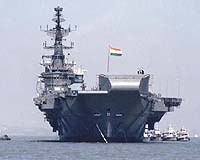
Washington (UPI) Jan 21, 2008 India is investing in a three aircraft carrier surface fleet -- something that Russia and France are incapable of, and that Japan and China have opted not to attempt. Only Britain has similar plans, apart from the great multi-carrier battle group of the U.S. Navy. India, in sharp contrast to U.S. ground strategy in Iraq in 2003 and thereafter, maintains very large numbers of ground forces that can be used to flood territories such as Jammu & Kashmir, or states threatened by Maoist rebels, with troops to provide on-the-ground security. This Indian emphasis on maintaining a very large ground army conflicts with the prevailing U.S. and even Russian doctrines on smaller, excellent equipped forces. But as the U.S. experience in Iraq showed, relying on such forces, however superb their training and equipment, can rapidly lead to strategic over-extension and the exhaustion of repeatedly deployed combat units. Nor do the Indians buy into the idea that the combination of precision-guided munitions and space-based targeting, reconnaissance and communications assets make any large land force obsolete and exceptionally vulnerable. That might be the case if they were ever caught up in a land war with the United States, which currently seems very unlikely. But against other potential enemies and threats on the Asian continent, New Delhi strategists believe large numbers of tanks will do just fine. The purchase of 347 Russian-made T-90 Main Battle Tanks concluded in December is also significant because it defies the long-prevailing wisdom that nations can only be global or regional superpowers if they make all their own primary weapons systems indigenously. If that were the case, Britain would have lost World War II and the Soviet Union would have had even greater difficulty in winning it: For Britain and the Soviet Union both depended on vast floods of American munitions: Tens of thousands of U.S. trucks, largely ferried across Iran, were crucial for the Soviet offensive drive on Berlin. India still lacks the heavy engineering capabilities in its growing domestic automotive industry to significant numbers of tanks, let alone Main Battle Tanks of the quality of the T-90. But purchasing them from other countries still looks good to them. China, for all its far vaster industrial production capability, still can only produce land weapons systems far inferior in quality to those of the United States and Russia, and has to buy them from Russia, though Moscow remains far more reluctant to sell its most up-to-date systems to China, in contrast to India, which it is eager to sell them to. Nor is India's rapidly strengthening military merely an exercise in nostalgia, investing solely in so-called cold fashioned weapons systems like aircraft carriers, large standing troop forces and aircraft carriers. New Delhi has also just signed a co-production deal with the Kremlin to make supersonic cruise missiles capable of flying at close to ground level three times faster than the U.S. Tomahawk. Indian leaders are also betting that they can make their ambitious endo-atmospheric and exo-atmospheric anti-ballistic missile interceptors and new Agni III intercontinental ballistic missile operational and produce them domestically in significant quantities in the next few years. But the T-90 purchase decision shows that even while the Indians share the American high-tech vision on BMD and high-tech systems, they are also keeping their feet -- and tank treads -- firmly on the ground to be able to defend themselves and project power in very traditional, but far from obsolete, ways. Community Email This Article Comment On This Article Related Links The Military Industrial Complex at SpaceWar.com Learn about the Superpowers of the 21st Century at SpaceWar.com
 BAE to buy Australian defence firm
 London (AFP) Jan 18, 2008
British defence group BAE Systems said Friday it had agreed to buy Australian defence contractor Tenix for up to 356 million pounds (478 million euros, 698 million US dollars). |
|
|

| The content herein, unless otherwise known to be public domain, are Copyright 1995-2007 - SpaceDaily.AFP and UPI Wire Stories are copyright Agence France-Presse and United Press International. ESA Portal Reports are copyright European Space Agency. All NASA sourced material is public domain. Additional copyrights may apply in whole or part to other bona fide parties. Advertising does not imply endorsement,agreement or approval of any opinions, statements or information provided by SpaceDaily on any Web page published or hosted by SpaceDaily. Privacy Statement |