|
 |
 |
 |
 |
 |
 |
 |
 |

 |
India Successfully Tests Surface To Air Missile
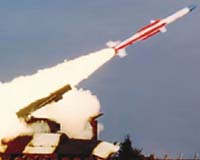
Bhubaneshwar, India (AFP) Dec 07, 2005 India successfully tested Wednesday a surface-to-air missile for the second time in five days from a coastal range in the east of the country, a defence official said. The domestically developed Akash missile was fired from the Chandipur-on-Sea testing site, 200 kilometres (125 miles) northeast of Orissa state capital Bhubaneswar, the official said, speaking on condition of anonymity. Wednesday's test was the fifth of the missile this year. The 700-kilogramme (1,540-pound) Akash, which means "sky" in Hindi, can track 100 targets simultaneously with onboard radar. It is able to move at a speed of 600 metres (yards) a second and deliver a 55-kilogram warhead across 27 kilometres in 50 seconds. The missile is one of five being developed by India's state-run Defence Research and Development Organization, which launched a project in 1983 to build an array of missiles. It hopes to cap the programme with a ballistic missile with a range of 5,000 kilometres. Nuclear-armed rivals India and Pakistan have fought three wars, two over the disputed Himalayan region of Kashmir, and frequently fire test missiles. The neighbours came close to a fourth war in 2002 but their relations have since warmed as part of a slow moving peace process aimed at settling their decades-old dispute over Kashmir. Source: Agence France-Presse Community Email This Article Comment On This Article Related Links SpaceDaily Search SpaceDaily Subscribe To SpaceDaily Express Learn about missile defense at SpaceWar.com All about missiles at SpaceWar.com
 LockMart/Netfires Tests Loitering Attack Missile Warhead
 Dallas TX (SPX) Jan 10, 2006
Lockheed Martin, part of the NetFires with Raytheon, recently performed eight successful tests of the Non-Line-of-Sight � Launch System's Loitering Attack Missile Multiple Explosively Formed Penetrator warhead. The tests proved the warhead's lethality against a wide variety of targets. |
|
|

| The content herein, unless otherwise known to be public domain, are Copyright 1995-2006 - SpaceDaily.AFP and UPI Wire Stories are copyright Agence France-Presse and United Press International. ESA PortalReports are copyright European Space Agency. All NASA sourced material is public domain. Additionalcopyrights may apply in whole or part to other bona fide parties. Advertising does not imply endorsement,agreement or approval of any opinions, statements or information provided by SpaceDaily on any Web page published or hosted by SpaceDaily. Privacy Statement |