|
 |
 |
 |
 |
 |
 |
 |
 |

 |
India Shrugs Off Failure Of Long-Range Missile
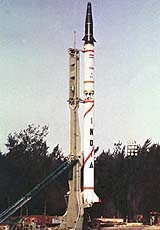
New Delhi (AFP) Jul 10, 2006 India Monday shrugged off the unsuccessful maiden test of its ambitious nuclear-capable long-range missile, as red-faced defence scientists began trying to work out what went wrong. "For the launching of missiles like Agni this kind of problem is not unusual and there is nothing to worry about it," Defence Minister Pranab Mukerjee was quoted as saying by the United News of India news agency. The Agni-III missile, which defence sources say has a range of 4,000 kilometres (2,480 miles), developed problems after a successful take-off Sunday from a site off India's east coast. A defence ministry official quoted in a report on the Times of India website Monday said scientists were "minutely" examining data collected from the tracking stations. "While it would be too early to hazard a guess as to what went wrong, it would seem that a design defect prevented the second stage from separating," the official said. "Because of this, the missile couldn't maintain its intended trajectory and could stay aloft for only five minutes instead of the 15 minutes it was intended to." The Agni-III has two solid-fuelled stages and has an overall diameter of 1.8 metres (six feet). Scientists of India's Defence Research and Development Organisation (DRDO) said more trials of the missile would be conducted in the coming months. "It was our first experiment with such a long range missile and in the next few days, we will analyse faults in order to rectify them," an unidentified scientist was quoted as saying by the Press Trust of India news agency. The test of the Agni-III missile had been postponed a number of times with reports citing pressure from the United States and technical problems. A highly-placed Defence Research and Development Organisation source told AFP on Sunday a snag in the booster rocket system of the missile had been detected two weeks ago but had been rectified. In May, Defence Minister Mukherjee had said the Agni-III, India's longest-range ballistic missile, was ready but that the country was observing "self-imposed restraint" before testing. Opposition parties criticised the announcement, saying testing was being delayed because of pressure from the United States. New Delhi and Washington reached a landmark deal in March that will see sanctions lifted on India's access to civilian nuclear technology. The Agni (Fire) is one of five missiles being developed by the DRDO under its Integrated Guided Missile Development Programme launched in 1983. The others are the land missile Prithvi (Earth), the surface-to-air Trishul (Trident), multi-purpose Akash (Sky), and the anti-tank Nag (Cobra).
Source: Agence France-Presse Community Email This Article Comment On This Article Related Links Learn about nuclear weapons doctrine and defense at SpaceWar.com Learn about missile defense at SpaceWar.com All about missiles at SpaceWar.com
 GD Selected As Manufacturer For GMLRS Unitary Warheads
 St Petersburg FL (SPX) Jul 11, 2006
General Dynamics Ordnance and Tactical Systems, a business unit of General Dynamics, has been selected from an international field of competition as the manufacturer of the Unitary Warhead for the Guided Multiple Launch Rocket System (GMLRS) by the U.S. Army and Lockheed Martin. |
|
|

| The content herein, unless otherwise known to be public domain, are Copyright 1995-2006 - SpaceDaily.AFP and UPI Wire Stories are copyright Agence France-Presse and United Press International. ESA PortalReports are copyright European Space Agency. All NASA sourced material is public domain. Additionalcopyrights may apply in whole or part to other bona fide parties. Advertising does not imply endorsement,agreement or approval of any opinions, statements or information provided by SpaceDaily on any Web page published or hosted by SpaceDaily. Privacy Statement |