|
 |
 |
 |
 |
 |
 |
 |
 |

 |
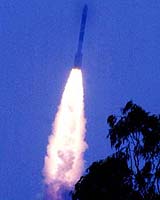
India Seeks Global Range Missile
Washington (UPI) Aug 30, 2005 India has served notice that it intends to make its global nuclear ballistic missile reach worldwide. The Deccan Herald has reported that India's Ministry of Defense, flushed with the success of its Agni medium range ballistic missile (MRBM), is pressing for the creation of a fully-fledged intercontinental ballistic missile with a range of 5,400 to 7,200 miles. The ICBM would probably be a three-stage ballistic missile with solid fuel rockets in the first and second stages, and a liquid propellant rocket in the third stage. The launch weight of the missile may reach 270-275 tonnes and it is planned to have an impact error of only around 1.2 miles to 1.7 miles, MoD officials in New Delhi told the newspaper. The missile may have a 5,480-7,680 pound releasable front section with two to three warheads of 15-20 kilotons each, the officials said. There are plans to use the second-stage propellant engine of the Vikas booster rocket during the development of the new missile to increase its flight range. The ICBM is likely to be test-fired by 2008 and is expected to be added to the Indian armed forces' deterrence arsenal by 2015, the Deccan Herald said. The Indian armed forces currently possess 12 ground-based Prithvi medium-range missile launchers with conventional warheads and a flight range of 90 to 150 miles with installation capabilities of single warheads with a yield of 10-15 kilotons. The same launchers could be used for the launch of ICBMs, the Deccan Herald said. These launchers are part of the 333rd Missile Regiment, based near the southern city of Hyderabad. The ICBMs developed by other countries use a ballistic trajectory involving a significant ascent and descent, including sub-orbital flight. Developing ICBMs would confirm India's status as a global power and put it in a select club including Russia, the United States, France, Britain and China, although North Korea and Iran are pushing ahead with ICBM programs too. While Agni is a two-stage solid fuel ballistic missile capable of delivering a 10-15 kiloton nuclear warhead up to 2,500 km, the ICBM will be a three-stage solid and liquid ballistic missile, the Deccan Herald said. The Defense Ministry officials also pointed out that there would be no monetary constraint for the project since many of the systems for the ICBM are similar to the current Agni missile that has already shown success and are being developed. India can probably count on whole-hearted U.S. cooperation in developing its new ICBM. The engineering challenges appear to be modest and well within India's current capabilities, U.S. experts in the field told UPI. But India's electronic and missile targeting technology remains far behind China's, and behind the targeting packages China is believed by Indian intelligence analysts to have supplied to Pakistan. The new ICBM will give India the deterrent capability to hit targets anywhere in China, including the capital Beijing. The current intermediate range Agni can only reach targets in southern China. Community Email This Article Comment On This Article Related Links SpaceDaily Search SpaceDaily Subscribe To SpaceDaily Express Learn about missile defense at SpaceWar.com All about missiles at SpaceWar.com
 Northrop Grumman Wins Contract For Target And Space-Launch Missile Work
 Reston VA (SPX) Jan 12, 2006
Northrop Grumman has been awarded a follow-on contract to provide technical support to the U.S. Air Force's Rocket Systems Launch Program (RSLP). |
|
|

| The content herein, unless otherwise known to be public domain, are Copyright 1995-2006 - SpaceDaily.AFP and UPI Wire Stories are copyright Agence France-Presse and United Press International. ESA PortalReports are copyright European Space Agency. All NASA sourced material is public domain. Additionalcopyrights may apply in whole or part to other bona fide parties. Advertising does not imply endorsement,agreement or approval of any opinions, statements or information provided by SpaceDaily on any Web page published or hosted by SpaceDaily. Privacy Statement |