|
 |
 |
 |
 |
 |
 |
 |
 |

 |
Increasing Nitrogen In Earth's Soils May Signal Global Changes
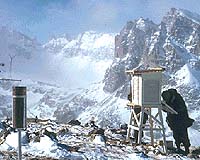
Boulder - Nov 04, 2002 The rapid increase of nitrogen falling from the sky as a result of fossil-fuel combustion and crop fertilization, combined with carbon stored in Earth's soils, could change the rate of the greenhouse gas, carbon dioxide, rising into the atmosphere, according to a new study. Scientists believe about 300 times more carbon is stored in soils than is being put in the atmosphere in the form of C02, according to biology Assistant Professor Alan Townsend of the University of Colorado at Boulder. Each year soils release about 20 times more carbon than industrial activities through decomposition. "Decomposition is primarily balanced by plant growth, but increasing nitrogen falling on ecosystems could change that balance," he said. The study shows tundra soils are unexpectedly sensitive to added nitrogen, bringing up the question of how increases in nitrogen throughout the world might affect C02 storage areas, or 'sinks,' on land," Townsend said. A paper on the subject by Townsend, co-principal author Jason Neff of the U.S. Geological Survey in Denver, Scott Lehman, Joyce Turnbull and William Bowman from CU-Boulder and Gerd Gleixner from Germany's Max Planck Institute will appear in the Oct. 31 issue of Nature. C02 in the atmosphere is believed to have risen by about one-third since the Industrial Revolution began in roughly 1760, contributing to a warming climate. "The nitrogen deposited on land might act like fertilizer and cause plants to grow more, at least for a while, which would suck up some carbon from the atmosphere," said Townsend, an associate at CU-Boulder's Arctic and Alpine Research Institute, along with co-authors Lehman, Turnbull and Bowman. "But it also could cause soils to lose some of their carbon, which would add even more C02 to the atmosphere." The study area was Niwot Ridge 35 miles west of Boulder, administered by INSTAAR and one of 20 Long-Term Ecological Sites in North America funded by the National Science Foundation. The big surprise is that many scientists believed soils would not respond so significantly to changes in nitrogen, he said. "One of our big concerns now is that we know the world's soils have at least three times more carbon than plants, and that increasing the nitrogen hitting these soils could change the size of that huge pool," he said. Since the pool is so large, even a small change could have a big effect on the atmosphere, and therefore future climate." Scientists have documented increases in how much C02 is being produced by human activity, and concluded that only about half of that amount is reaching the atmosphere, said Townsend. So the carbon sinks on Earth taking up and storing the carbon molecules in the world's vegetation, soils and oceans must be immense, he said. "If these sinks slow down or turn off in the near future, we could see much larger increases in atmospheric C02," said Townsend. "If cold tundra soils are sensitive to nitrogen, it raises concerns about what might be happening in other, warmer parts of the world where things can change more rapidly," he said. "Niwot Ridge is by no means unique," said Townsend. "Nitrogen deposition is going up all over the world, especially throughout the United States, Europe and much of Asia." In the eastern United States, for example, scientists are seeing as much as 10 times more nitrogen flowing into the rivers compared to just a few decades ago. "I think the problems we are seeing from the altered nitrogen cycle are worse than what we are seeing in climate change around the world, at least for now," he said. "In the history of the Earth, half the nitrogen fertilizer ever used has been applied since 1990. A lot of this nitrogen does not go where it is supposed to, causing a cascade of environmental problems that are worsening at an alarming rate." Although rivers like the Mississippi have many times the amount of nitrogen than they contained 30 years ago, there are "tractable solutions" to the problem, he said. "Agricultural extension services often recommend more nitrogen than is needed for fertilization, and some farmers tend to put on even more nitrogen." Trying to calculate the nitrogen turnover rate of carbon in soils is difficult, he said. "In a lot of the world, far more fertilizer is used than is needed to maximize crop growth, and it is this extra use that causes a lot of the problems. In many cases, farmers could make small changes in how much fertilizer they use, or when they use it, but make a big difference in how much nitrogen leaks off their fields." It is far too soon to say if more nitrogen in the world's soils will mean more or less C02 in the atmosphere, Neff said. "Soils contain a huge mix of different types of carbon, and it likely does all respond the same to changing nitrogen. But that is what we saw at Niwot Ridge, and the same probably is true elsewhere." Community Email This Article Comment On This Article Related Links Townsend Lab at University of Colorado at Boulder Niwot Ridge (Colorado) Long-Term Ecological Research SpaceDaily Search SpaceDaily Subscribe To SpaceDaily Express Dirt, rocks and all the stuff we stand on firmly
 Magnetic Reconnection Region Larger Than 2.5 Million Km Found In The Solar Wind
 Paris (ESA) Jan 12, 2006
Using the ESA Cluster spacecraft and the NASA Wind and ACE satellites, a team of American and European scientists have discovered the largest jets of particles created between the Earth and the Sun by magnetic reconnection. This result makes the cover of this week's issue of Nature. |
|
|

| The content herein, unless otherwise known to be public domain, are Copyright 1995-2006 - SpaceDaily.AFP and UPI Wire Stories are copyright Agence France-Presse and United Press International. ESA PortalReports are copyright European Space Agency. All NASA sourced material is public domain. Additionalcopyrights may apply in whole or part to other bona fide parties. Advertising does not imply endorsement,agreement or approval of any opinions, statements or information provided by SpaceDaily on any Web page published or hosted by SpaceDaily. Privacy Statement |