|
 |
 |
 |
 |
 |
 |
 |
 |

 |
In The Stars: Hubble At 15, And Still Unmatched
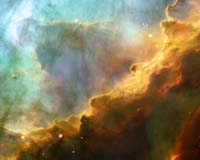
Washington (UPI) Apr 25, 2005 A spectacular new era in astronomy began on April 25, 1990, although it took most of the world a while to appreciate the magnitude of the change. On that date, the Hubble Space Telescope, launched by NASA the previous day, first opened its eyes to the heavens. Despite its ungainly appearance - the schoolbus-sized spacecraft looks like a tall aluminum beer can stacked atop a delabeled large-sized can of tomato sauce and flanked by twin solar panels - the $1.5 billion instrument carried the most advanced astronomical equipment available to begin a two-decade-long mission of probing the heavens more deeply than ever before. At least, that was the original plan. It turned out, however, that despite years of planning and testing, the telescope's designers and builders had let Hubble fly carrying a major flaw: Its primary mirror was out of focus, so the first images returned to Earth were, to put it mildly, disappointing. It took a daring repair mission mounted by the crew of the space shuttle Endeavour between Dec. 5-9, 1993, to correct Hubble's problem. The mission - the first of four over the years - required five space walks totaling nearly 35 1/2 hours, but it gave the telescope the visual acuity its designers had intended. Very soon, the 12-ton telescope began reclassifying as obsolete all previous concepts of what observations of the night sky should produce. In image after stunning image, Hubble gave human observers a look at previously unknown places: clouds of gas back-lit by the heat and light of supernovae, giant spiral galaxies mated with smaller companions, galaxies in the process of collision, galaxies of unusual shape, illuminated clouds astronomers identified as the hatcheries of young stars. Nearer to Earth, Hubble photographed the planets of the solar system with unparalleled clarity, bringing a red Mars, massive Jupiter, ringed Saturn and canted Uranus into razor-sharp focus. Hubble even managed to capture a cataclysmic event when the 21 fragments of Comet Shoemaker-Levy plowed into Jupiter's cloud tops over the course of a week starting July 16, 1994. Maybe the most famous image of all turned out to be due to the marketing sense of the Hubble team's scientists. In November 1995, the telescope's Wide Field and Planetary Camera 2 captured a striking nebula - cataloged as M16, but called Eagle - in a relatively nearby region of the Milky Way called Eagle, about 6,500 light-years away in the constellation Serpens. For the first time, Hubble's image allowed astronomers to view a phenomenon called evaporating gaseous globules, or EGGs - dense, compact pockets of interstellar gas in the process of forming stars. No doubt it was valuable scientifically. "For a long time astronomers have speculated about what processes control the sizes of stars - about why stars are the sizes that they are," Jeff Hester, of Arizona State University in Tempe and an image team member, said at the time. "Now in M16 we seem to be watching at least one such process at work right in front of our eyes." The real sensation, however, arose because the Hubble team took the image, which originally appeared downward, and reversed its orientation, then named it the "Pillars of Creation." Instead of bright regions lurking below long and ominous-appearing tendrils of gas, and resembling stalactites with glowing tips, the image released to the public suggested something grand and majestic - halos protruding from monstrous columns light-years in length. "This is the first time that we have actually seen the process of forming stars," Hester said. The Eagle Nebula image quickly became one of the most popular and recognizable images of astronomy. It presented something truly awesome, suggesting the universe could be full of such inspiring sites. Though less dramatic visually, Hubble's greatest achievement so far is the image captured in late 2004 by its Ultra-Deep Field camera. An exposure requiring 1 million seconds and focusing on an ostensibly empty area of the sky near the constellation Orion, the image probed more deeply into space and the past than anything ever attempted before - about 12 billion light years. There are about 10,000 objects in the UDF image, and each one is a galaxy. The implication is inescapable: This relatively tiny, seemingly empty patch of the night sky is teeming with galaxies, each containing at least tens of billions of stars. The sad news about Hubble's odyssey is it probably is going to end soon. Of the six gyroscopes the spacecraft carries to enable it to focus on a fixed point in the sky, three have shut down. Hubble can continue to perform its mission with the three remaining units, but if one more gyroscope fails, it will lose its ability to maintain the quality of its images. NASA had commissioned a fifth shuttle servicing mission to Hubble, but canceled it after the Columbia disaster in February 2003. Now, Michael Griffin, the agency's new head, is attempting to decide whether to risk that mission to extend the telescope's operational lifetime. What Griffin decides could affect the state of visible-light astronomy perhaps for decades, because as of now, there is no immediate replacement for Hubble. Its place in the history of science seems, for the moment - and sadly - unique. In the Stars is a series examining new discoveries about the cosmos, by Phil Berardelli, UPI's Science & Technology Editor. E-mail: [email protected] Community Email This Article Comment On This Article Related Links SpaceDaily Search SpaceDaily Subscribe To SpaceDaily Express Space Telescope News and Technology at Skynightly.com
 Carl Zeiss And Max Planck Researchers Develop Optical Technology For JWST
 Heidelberg, Germany (SPX) Dec 09, 2005
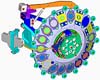
Carl Zeiss Optronics, in Oberkochen, Germany, and the Max Planck Institute for Astronomy in Heidelberg (MPIA), are developing the main fine mechanical optical technology for two instruments to be part of the James Webb Space Telescope (JWST). |
|
|

| The content herein, unless otherwise known to be public domain, are Copyright 1995-2006 - SpaceDaily.AFP and UPI Wire Stories are copyright Agence France-Presse and United Press International. ESA PortalReports are copyright European Space Agency. All NASA sourced material is public domain. Additionalcopyrights may apply in whole or part to other bona fide parties. Advertising does not imply endorsement,agreement or approval of any opinions, statements or information provided by SpaceDaily on any Web page published or hosted by SpaceDaily. Privacy Statement |