|
 |
 |
 |
 |
 |
 |
 |
 |

 |
In Search Of Hot Stuff Like Saturn
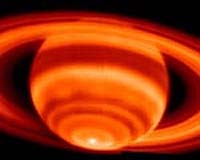
London, UK (SPX) Feb 05, 2007 UCL researchers have reported findings in the journal 'Nature' that rule out a long-held theory about why the gas giants like Saturn have such hot outer atmospheres. Along with colleagues from Boston University, the team from UCL Physics and Astronomy found that the upper atmospheres of the giant planets in our solar system do not heat up in the same way as here on Earth. A simple calculation to give the expected temperature of a planet's upper atmosphere balances the amount of sunlight absorbed by the energy lost to the lower atmosphere. However, the calculated values don't tally with the actual observations of the gas giants - they are consistently much hotter. It has long been thought that the culprit behind the heating process was the ionosphere, being driven by the planet's magnetic field, or magnetosphere. On the Earth this is seen in the auroral region where the spectacular Aurora Borealis, or Northen Lights, show where this energy transfer is taking place. By analogy, it was believed the heating effect on the gas giants would be similar. The 'auroral zone' heating would then somehow be distributed to lower latitudes, though this is difficult to do because the high spin rates of these planets tends to prevent north-south movement. The UCL team was investigating this redistribution when they reached their surprising conclusion. By using numerical models of Saturn's atmosphere, the researchers found that there, the net effects of the winds driven by polar energy inputs is not to heat the atmosphere, but to actually cool it equatorward of the heated region. The study was funded by the UK Particle Physics and Astronomy Research Council (PPARC) and Sun Microsystems Ltd and carried out using the High-Performance Service for Physics, Astronomy, Chemistry and Earth Sciences (HiPerSPACE) computing facility at UCL. Study author Professor Alan Aylward (UCL Physics and Astronomy) explained: "The aurora has been studied for over a hundred years, yet our discovery takes us back to first principles. We need to re-examine our basic assumptions about planetary atmospheres and what causes the observed heating. Studying what happens on planets such as Saturn gives us an insight into what happens closer to home. Planets can lose their atmospheres as we see with Mars, and by studying what happens in other atmospheres we may find clues to Earth's future." Community Email This Article Comment On This Article Related Links University College London Stellar Chemistry, The Universe And All Within It Beyond Sol Stellar Chemistry, The Universe And All Within It
 UK Astronomer To Lead European Project To Develop A New Roadmap To The Stars
 Liverpool UK (SPX) Jan 25, 2007
Michael Bode, Professor of Astrophysics at Liverpool John Moores University, has been charged with the vital task of developing the new 'roadmap', which will act as the blue print for the development of astronomy in Europe over the next 20 years. The roadmap will detail the infrastructure needed to deliver European astronomy's science vision - being agreed at a conference in Poitiers now (23-25th January 2007) hosted and organised by ASTRONET, a consortium of eleven European Science Agencies. |
|
|

| The content herein, unless otherwise known to be public domain, are Copyright 1995-2006 - SpaceDaily.AFP and UPI Wire Stories are copyright Agence France-Presse and United Press International. ESA PortalReports are copyright European Space Agency. All NASA sourced material is public domain. Additionalcopyrights may apply in whole or part to other bona fide parties. Advertising does not imply endorsement,agreement or approval of any opinions, statements or information provided by SpaceDaily on any Web page published or hosted by SpaceDaily. Privacy Statement |