
 |
 |
 |
 |
 |
 |
 |
 |
 |

 |
Improving Swine Waste Fertilizer
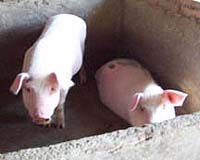
Madison WI (SPX) Jul 10, 2008 Swine production generates large amounts of waste. While this waste contains nutrients that may serve as fertilizer when applied to agricultural fields, the ratio of nutrients in the waste is different than what a crop requires. Application of waste to meet the nitrogen needs of a crop results in application of excess phosphorus which increases the potential for environmental contamination. Swine fed corn diets with more highly available phosphorus produce waste that has a nitrogen to phosphorus ratio closer to what a crop needs than swine fed traditional corn diets. The use of swine waste for fertilizer has double benefits for the environment. Using swine waste reduces the need for chemical fertilizers for crops and at the same time reduces the amount of waste to be disposed of from swine production. But, when the nutrients in the swine waste don't match the needs of the crops, the excess nutrients not used by the crops can pollute the soil. Scientists with USDA-ARS and the University of Nebraska - Lincoln compared nitrogen and phosphorus availability in field plots receiving inorganic fertilizer, manure from swine fed traditional corn diets, or manure from swine fed low phytate corn diets. Results from the study were published in the Soil Science Society of America Journal. Researchers found that field application of slurry from low-phytate corn diets at rates needed to meet the nitrogen needs of the crop results in slower accumulation of phosphorus in these soils. Community Email This Article Comment On This Article Share This Article With Planet Earth
Related Links Soil Science Society of America Our Polluted World and Cleaning It Up
 Pesticides Persist In Ground Water
 Madison WI (SPX) Jul 10, 2008
Numerous studies over the past four decades have established that pesticides, which are typically applied at the land surface, can move downward through the unsaturated zone to reach the water table at detectable concentrations. |
|
|

| The content herein, unless otherwise known to be public domain, are Copyright 1995-2007 - SpaceDaily.AFP and UPI Wire Stories are copyright Agence France-Presse and United Press International. ESA Portal Reports are copyright European Space Agency. All NASA sourced material is public domain. Additional copyrights may apply in whole or part to other bona fide parties. Advertising does not imply endorsement,agreement or approval of any opinions, statements or information provided by SpaceDaily on any Web page published or hosted by SpaceDaily. Privacy Statement |
 del.icio.us
 Digg
Digg Reddit
 YahooMyWeb
 Google
 Facebook