|
 |
 |
 |
 |
 |
 |
 |
 |

 |
Ill South Pole Worker Safely Evacuated
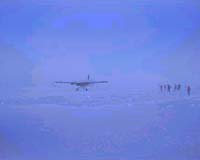
Arlington - Sep 24, 2003 An ill worker at the National Science Foundation's Amundsen-Scott South Pole Station in Antarctica has been evacuated from Antarctica and is en route to United States for medical treatment. NSF manages the U.S. Antarctic Program (USAP), which coordinates all U.S. scientific research and logistics support on the southernmost continent. The rescue aircraft, a two-engine DeHavilland "Twin Otter" departed from the Pole at 5 a.m. Eastern Time (ET) Sunday and arrived at the British Antarctic Survey's Rothera Station on the Antarctic Peninsula at 1:51 p.m. ET the same day. The crew included a pilot, co-pilot, flight engineer, a physician's assistant and the patient. The patient, an employee of Raytheon Polar Services Co. (RPSC), of Centennial, Colo., NSF's Antarctic logistics contractor, has requested anonymity. NSF is honoring that request. The specifics of the patient's condition are being kept confidential. The illness is not contagious and no one else at the station was at risk. The patient remains in stable condition and will travel to a U.S. hospital for treatment. NSF is withholding the hospital's location to protect the patient's identity. "I am extremely gratified that this flight has been carried out safely and that the patient will soon be receiving a level of sophisticated and expert medical care that is simply unavailable in Antarctica," said Karl Erb, who heads the U.S. Antarctic Program. "I congratulate and thank everyone who assisted in making this a successful operation, especially the aircrews and our team at Pole. I also would like particularly to express my gratitude to the British Antarctic Survey for providing the crucial assistance that made this flight not only successful, but safe." The Twin Otter, operated by Kenn Borek Air Ltd. Of Alberta, Canada, under contract to RPSC in support of the U.S. Antarctic Program, returned to Rothera. The evacuation plane and another Kenn Borek Twin Otter then flew on to Punta Arenas, Chile, arriving on Sunday night, Sept. 21 ET. The aircraft's pilot based his decision to fly to Rothera, primarily on the Rothera weather forecast and to minimize the risk to both the patient and the aircrew. The decision to attempt the evacuation was made on Sept. 20 after the pilots and NSF received a favorable weather forecast. The planes waited several days at Rothera for favorable weather. The extremely changeable weather, as the Antarctica winter gives way to spring, made the evacuation particularly difficult. The Twin Otter pilots relied on weather forecasts developed by SPAWAR Systems Center, in Charleston, S.C., in cooperation with the British Antarctic Survey and British weather forecasters in the Falkland Islands. Weather models developed jointly at Ohio State University and the National Center for Atmospheric Research (NCAR) were critical in planning. Officials of NSF's Office of Polar Programs have been consulting with the South Pole station's physician and medical specialists in the United States at the University Texas Medical Branch in Houston, Johns Hopkins University, Brigham and Women's Hospital, an affiliate of Harvard Medical School, and radiologists and internists in the Denver area via a telemedicine link to provide the appropriate care and to guide medical decisions. But concern that the individual's condition could possibly worsen prompted the evacuation decision. Various contingencies for bringing the patient safely back to the United States were considered to take advantage of the best weather opportunities. On Sunday, the Borek pilot deemed the forecast at Rothera made a flight from the Pole to the Antarctic Peninsula there safer and more expeditious than to McMurdo. As spring comes to the Southern Hemisphere, normal flight operations will soon commence to support the several thousand researchers and other personnel who travel to Antarctica under the auspices of the U.S. Antarctic Program. The program's airlift capacity includes the Borek Twin Otters as well as U.S. Air Force C-141s and C-17s, ski-equipped LC-130 Hercules transport planes flown by the New York Air National Guard and RZNAF C-130s. Usually, the first flights into coastal McMurdo take place at the end of September. Flights to the South Pole, however, do not begin until late October or early November, when temperatures have increased. The average temperature at the Pole at this time of year is �60 degrees Celsius (�76 degrees Fahrenheit). This year, 58 scientists and staff are spending the austral winter at the South Pole station. Some are overseeing the operation of highly sophisticated telescopes that take advantage of the pristine Polar atmosphere as an astronomy observatory, some are working on building a new, modern station at the Pole and others work in a variety of support roles that keep the station functioning. In April of 2001, South Pole Physician Ronald Shemenski was evacuated for treatment of pancreatitis. At that time, the evacuation flight through the cold and darkness of the six-month polar night was one of the most challenging on record. Community Email This Article Comment On This Article Related Links SpaceDaily Search SpaceDaily Subscribe To SpaceDaily Express Space Medicine Technology and Systems
 Florida Tech, FSRI Receive $1.3 Million Federal Grant For Space Research
 Melbourne FL (SPX) Jan 11, 2006
NASA's FY-2006 budget includes a $1.3 million grant, at Florida Congressman Dave Weldon's request, for a life sciences research collaboration between the Florida Institute of Technology and the Florida Space Research Institute (FSRI). |
|
|

| The content herein, unless otherwise known to be public domain, are Copyright 1995-2006 - SpaceDaily.AFP and UPI Wire Stories are copyright Agence France-Presse and United Press International. ESA PortalReports are copyright European Space Agency. All NASA sourced material is public domain. Additionalcopyrights may apply in whole or part to other bona fide parties. Advertising does not imply endorsement,agreement or approval of any opinions, statements or information provided by SpaceDaily on any Web page published or hosted by SpaceDaily. Privacy Statement |