|
 |
 |
 |
 |
 |
 |
 |
 |

 |
Icing: A Chilling Subject
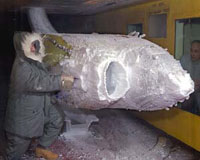
Cleveland (SPX) Apr 29, 2004 Ice. It's great to cool beverages with and skate on, but it's often hazardous to aircraft. That's why NASA's Glenn Research Center (GRC) in Cleveland built what was once the largest Icing Research Tunnel (IRT) in the world in the mid-1940s. NASA realized the need to improve aircraft safety by increasing technical and in-flight awareness about icing conditions. One of Glenn's busiest facilities, the 9 foot wide by 6 foot tall icing tunnel can generate airspeeds from 50 to over 400 miles per hour and temperatures as low as minus 40 degrees Fahrenheit. Natural icing conditions are simulated by subjecting the models to supercooled water droplets of varying sizes and water content. Planes have had ice protection systems in place since the 1930s, but aircraft technology, size and distance traveled have changed significantly. And so has Glenn's IRT. It has been updated to accommodate the current gas turbine-powered aircraft, electronic data gathering and computerized controls. An aircraft's exterior surface, such as the upper wing and body, are the most vulnerable areas for ice formation while awaiting takeoff. Glenn's research team has played a role in testing and certifying methods, like anti-icing fluids, to prevent ice build-up on aircraft while still on the ground. But icing on aircraft in flight could be just as harmful as it is on the ground. When flying through clouds, ice tends to form on the most sensitive areas like the leading edges of the wing and tail, according to Tom Ratvasky, one of Glenn's leading icing flight researchers. Glenn uses, as part of its aerial research facility, a DeHavilland DHC-6 Twin Otter aircraft, which is considered a "flying laboratory." The Twin Otter turbo prop has seen many years of service. Having undergone extensive modification, the lab in the sky has helped researchers gain information on icing physics studies, protection systems and remote-sensing technologies. The in-flight icing research activities will soon be aided by a new addition to Glenn. A former Navy S-3 Viking aircraft was recently transferred to NASA and will undergo modifications to provide a state-of-the-art flying laboratory by 2006. Image to left: The Navy Viking S-3 jet aircraft will play an instrumental role in Glenn's ongoing icing flight research, developing new knowledge of icing conditions and in defining the effects of ice build-up on aircraft performance and handling abilities. Credit: NASA/Tom Jares With the increased speed, range and electrical power generation that the S-3 offers, the icing flight research that NASA conducts will be more geared to today's air transportation system. The S-3's data will be used to support improvements in aviation weather forecasting, icing simulation tool development, icing cloud characterization and pilot training materials. NASA's Glenn Research Center is supported by the Ames Research Center, Moffett Field, Calif., Langley Research Center, Hampton, Va., other industry partners and the Federal Aviation Administration. They are working to improve the ever-present icing conditions that affect every craft that leaves the Earth. Community Email This Article Comment On This Article Related Links Icing Research at Glenn SpaceDaily Search SpaceDaily Subscribe To SpaceDaily Express Space Tourism, Space Transport and Space Exploration News
 NASA Refines Design For Crew Exploration Vehicle
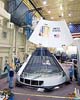 Washington DC (SPX) Jan 12, 2006
NASA's Constellation Program is making progress toward selecting a prime contractor to design, develop and build the Crew Exploration Vehicle (CEV), America's first new human spacecraft in 30 years. |
|
|

| The content herein, unless otherwise known to be public domain, are Copyright 1995-2006 - SpaceDaily.AFP and UPI Wire Stories are copyright Agence France-Presse and United Press International. ESA PortalReports are copyright European Space Agency. All NASA sourced material is public domain. Additionalcopyrights may apply in whole or part to other bona fide parties. Advertising does not imply endorsement,agreement or approval of any opinions, statements or information provided by SpaceDaily on any Web page published or hosted by SpaceDaily. Privacy Statement |