|
 |
 |
 |
 |
 |
 |
 |
 |

 |
IST Debuts Its Stationary Plasma Thrusters On Loral-Built MBSAT Satellite
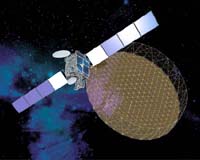
Palo Alto CA (SPX) Jun 29, 2004 International Space Technologies, Inc. (ISTI), a developer of stationary plasma thrusters (SPT) used to keep satellites on station, announced Monday that its SPTs have been successfully deployed, tested and are now being used in routine on-station operations on the recently launched MBSAT satellite, built by Space Systems/Loral (SS/L), Palo Alto, Calif. for Mobile Broadcasting Corporation (MBCO) of Japan and SK Telecom of Korea. ISTI is a joint venture of Fakel Experimental Design Bureau of Kaliningrad, Russia, Snecma Moteurs of France and SS/L, a subsidiary of Loral Space & Communications. MBSAT, which was successfully launched on March 13, 2004, uses SPTs for North/South station keeping maneuvers that keep a satellite in its proper position throughout the satellite's 12-year operational life. Since the satellite's launch, MBSAT's SPTs have logged over 100 hours of routine orbit maneuvers. SPTs are low thrust, Hall-effect thrusters that use available spacecraft electrical power to ionize and accelerate an inert gas, Xenon, to create the thrust to move the satellite. They are controlled and powered by specially developed and highly efficient Power Processing Units designed and manufactured by Space Systems/Loral. "The successful in-orbit testing of MBSAT's SPTs is a significant step that validates the technology's ability to reduce the amount of propellant satellites must carry to keep spacecraft in correct orbital position and attitude," said Michael Day, ISTI vice president. "The amount of propellant saved can be more than 20 percent of the total mass of a spacecraft, freeing up volume and carrying capacity that can be used for larger, more powerful and flexible payloads," Mr. Day added. "SPT development is part of the on-going drive of the satellite industry to improve satellite performance and reliability." Two more satellites under construction at SS/L - Intelsat Americas 8 (formerly Telstar 8) and Shin Satellite's iPSTAR - also will carry the thrusters when they are launched later this year. Together, Snecma Moteurs and SS/L have purchased more than 50 SPTs from ISTI. Snecma supplies SPTs to European satellite manufacturers and SS/L will use them on spacecraft it builds. Community Email This Article Comment On This Article Related Links Loral Space & Communications Snecma Moteurs SpaceDaily Search SpaceDaily Subscribe To SpaceDaily Express Space Technology News - Applications and Research
 TeleRay Mobile Sat TV Antenna For Japan Auto Market
 Las Vegas CA (SPX) Jan 5, 2006
RaySat has introduced TeleRay, the world's smallest satellite TV vehicle antenna, into the domestic Japanese automotive market. |
|
|

| The content herein, unless otherwise known to be public domain, are Copyright 1995-2006 - SpaceDaily.AFP and UPI Wire Stories are copyright Agence France-Presse and United Press International. ESA PortalReports are copyright European Space Agency. All NASA sourced material is public domain. Additionalcopyrights may apply in whole or part to other bona fide parties. Advertising does not imply endorsement,agreement or approval of any opinions, statements or information provided by SpaceDaily on any Web page published or hosted by SpaceDaily. Privacy Statement |