|
 |
 |
 |
 |
 |
 |
 |
 |

 |
ISS Ready To Crank Out The Material Science
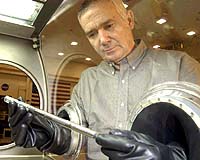
Huntsville - Jun 05, 2002 First materials science experiments head to International Space Station 'Bad bubbles,' semiconductors, new furnaces make Space Station 'hotbed' for materials research Scientists will soon turn the International Space Station into a materials research laboratory to study "bad bubbles" that cause defects in metal alloys used to produce engine turbine blades and semiconductor crystals that are crucial components in electronic devices. In a mission to the International Space Station this week, Space Shuttle Endeavour will deliver two novel furnaces and more than 20 ampoules filled with materials samples for the first two NASA materials science experiments conducted on the Space Station. "We can thank advances in materials science for everything from cell phones to airplanes to computers to the next space ship in the making," said Dr. Donald Gillies, NASA's discipline leader for materials science at the Marshall Space Flight Center in Huntsville, Ala. "To improve materials needed in our high-tech economy and help industry create the hot new products of the future, NASA scientists are using low gravity to examine and understand the role processing plays in creating materials." Bubbles are a good example of the way microgravity - the near-weightless environment created as the Space Station orbits Earth - influences the properties of materials as they are produced. On Earth when scientists melt metals, bubbles that form in the molten material generally rise to the surface, pop and disappear. In low-gravity, the bubbles may only move slightly. "Bubbles sound simple," said Dr. Richard Grugel, lead scientist for the Pore Formation and Mobility Investigation (PFMI) at the Marshall Center. "But when bubbles are trapped in solid samples, they show up as internal cracks that diminish a material's strength and usefulness, whether it's processed on Earth or in space." Grugel's furnace will melt and resolidify samples of a transparent modeling material, succinonitrile and succinonitrile water mixtures. "Bubbles are more likely to get trapped in samples processed in microgravity, which makes it an excellent place to study their movements and interactions," said Grugel. "The information gleaned from the experiments will promote our knowledge of bubble dynamics and provide needed insight regarding materials processing of metals and alloys in space." Observing and controlling his Space Station experiment from the telescience operations room at the Marshall Center, Grugel will scrutinize bubbles in prepared samples and study their behavior. He'll send commands to the experiment in space, changing the processing temperature and other parameters to systematically investigate the conditions that stimulate bubble movement and eventual pore formation. The other materials science experiment to be delivered on this month's STS-111 mission - the Solidification Using a Baffle in Sealed Ampoules, or SUBSA -- will study solidification of semiconductor crystals from the melt. Semiconductors are used in electronic devices such as computer chips and integrated circuits, medical imaging devices, and detectors of nuclear and infrared radiation. For this investigation, indium antimonide crystals previously solidified on Earth are melted and then cooled to resolidify in microgravity and form solid single crystals. To control the electronic properties of the crystals, tiny quantities of tellurium or zinc is added to the indium antimonide. The lead scientist for the experiment selected indium antimonide because of its relatively low melting point of 512 degrees Celsius and because it is useful for creating models that apply to a variety of semiconductor materials. "On Earth, buoyancy continuously deforms and moves fluids in complex manners, making it difficult to study how materials that solidify from the melt form semiconductors and other products," said Dr. Aleksandar Ostrogorsky, the SUBSA principal investigator who also teaches and conducts research at the Rensselaer Polytechnic Institute in Troy, N.Y. "In microgravity, the fluids are almost stagnant, resembling solids. The absence of motion makes it easier to observe and mathematically describe what is occurring when the crystals are melted, and how the materials solidify to form a new crystal." The semiconductor crystals are contained in cylindrical glass tubes, called ampoules, which astronauts insert into the SUBSA furnace for processing. Ostrogorsky will observe each sample as it is processed and send commands to his space furnaces -- tweaking the experiment, much as he would in a ground-based laboratory. Ostrogorsky and Grugel will each process at least 10 samples. Ostrogorsky's samples are scheduled to be processed first and returned on Space Shuttle Endeavour when it visits the Station this fall. Grugel's experiment will begin later during Expedition Five and continue until the samples are returned on Space Shuttle Atlantis during the STS-114 mission early next year. These experiments are possible because the two high-temperature furnaces can be enclosed inside the Microgravity Science Glovebox - a major new research facility also being delivered to the Space Station this month. The glovebox safely contains the materials being processed, and has a large front window with built-in gloves allowing astronauts to change out samples and perform other important tasks. The glovebox, built by the European Space Agency in collaboration with engineers at the Marshall Center, makes it possible to do many new types of hands-on science experiments. "As the launch gets closer, my students and I are getting more excited that our experiment is actually going to be one of the first materials science experiments carried out on the Space Station," said Ostrogorsky. "We have done extensive work on the ground to prepare for the experiment, and we believe that the prolonged processing times available on the Station will allow scientists to do meaningful and reproducible materials research in space," added Ostrogorsky. The new experiments will get under way during Expedition Five on the Space Station - the next four-month research period on the orbiting laboratory that starts with delivery of these and other experiments to the Station during the STS-111 mission. The research is sponsored by NASA's Microgravity Research Program at the Marshall Center and by the Office of Biological and Physical Research in Washington, D.C. Community Email This Article Comment On This Article Related Links ISS Science Operations Microgravity Research Office of Biological and Physical Research SpaceDaily Search SpaceDaily Subscribe To SpaceDaily Express Space Station News at Space-Travel.Com
 NASA Had No Choice But To Buy Soyuz Flights
 Washington DC (SPX) Jan 09, 2006
NASA's announcement last week that it will pay Roskosmos $43.6 million for a round-trip ride to the International Space Station this spring, and an equivalent figure for an as-yet-undetermined number of future flights to the station until 2012, represents the agency's acknowledgment that it had no alternative. |
|
|

| The content herein, unless otherwise known to be public domain, are Copyright 1995-2006 - SpaceDaily.AFP and UPI Wire Stories are copyright Agence France-Presse and United Press International. ESA PortalReports are copyright European Space Agency. All NASA sourced material is public domain. Additionalcopyrights may apply in whole or part to other bona fide parties. Advertising does not imply endorsement,agreement or approval of any opinions, statements or information provided by SpaceDaily on any Web page published or hosted by SpaceDaily. Privacy Statement |