|
 |
 |
 |
 |
 |
 |
 |
 |

 |
ISS Gets A Bit Bigger
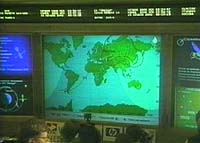
Korolev (AFP) July 26, 2000 - The International Space Station took a vital step forward Wednesday as a Russian-made module housing the living and working quarters cautiously docked to the orbiter after years of delay. To a relieved burst of applause at mission control, the 320-million-dollar Zvezda module docked automatically at 0045 GMT after a year-long delay caused by severe cash constraints in Russia's once proud space program. The first mission may now fly to the ISS in October, although the giant station -- which will eventually be visible from Earth -- will not be completed for another five years. The Zvezda, or Star, module is now linked up to the first Russian element called Zarya and the US-built Unity. It will also house the navigation and guidance systems until another US module assumes those functions. "Today is a great day, because a project which we have worked on for six years has been successfully completed," said Russia's space agency director Yury Koptev, who exchanged congratulations by phone with NASA administrator Daniel Goldin. US National Aeronautics and Space Administration (NASA) official in Korolev, Robert Castle, was clearly pleased by the successful docking. "It's the start of a new era," he said. Yury Semyonov, president of Energia the Russian company which built Zvezda, called it a "key moment" in the development of the space station. Zvezda was financed almost entirely by the Russians. However, the US fast food giant Pizza Hut has alleviated some of the financial difficulties in return for having its logo emblazoned on the side of the launcher rocket. The publicity stunt is reportedly costing Pizza Hut one million dollars, the Russian business daily Kommersant reported, but the space agency has refused to confirm the sum. The first Zarya module was built in Russia, but financed entirely by the US. The International Space Station is a project involving 16 countries, including the United States, Canada, Japan and Russia. When finished, the complex will be 100 meters (yards) long, and weigh more than 450 tonnes. The stage is now set for the first ISS team of US commander William Shepherd and Russian cosmonauts Yury Gidzenko and Sergei Krikalyov will blast off on the Russian space craft Soyuz on October 30. Zvezda's launch on July 12 had been delayed for a year due to financial and technical problems. The giant floating laboratory is expected to remain in service until 2013.
|
Korolev - July 26, 2000 - With the ISS� Zarya Control Module operating as the active vehicle, the two craft gently docked at 7:45 p.m. Central time (4:45 a.m. Moscow time on July 26), two weeks after Zvezda rocketed into space from the Baikonur Cosmodrome in Kazakhstan. Zarya�s jets controlled the final minutes of the approach for docking, as the ISS closed on Zvezda at a glacial rate of two-tenths of a meter per second. Within minutes, hooks and latches on both sides of the docking interface between Zvezda and Zarya began to engage one another to form a tight seal between the two vehicles. The ISS had become a far larger complex at the moment of docking, now spanning 119 feet in length, or the size of an 11-story building. The ISS now weighs almost 60 tons. Immediately after docking, the solar arrays on Zvezda, which had been locked "edge on" to prevent any impingement from Zarya�s jet thrusters, began articulating again to follow the sun and Zarya�s Motion Control System was deactivated. Upon command from Russian flight controllers, a valve in Zvezda will be opened to pressurize the vestibule, or passageway, between the two modules. On Sunday, U.S. time, flight controllers in Korolev will begin the critical transfer of commanding and attitude control of the ISS from Zarya�s computers to those on Zvezda, part of the command and telemetry system in the Service Module supplied by the European Space Agency.
With tonight�s successful docking, technicians at Baikonur were scheduled to begin fueling the first Progress resupply vehicle for the ISS, which is scheduled for launch on a Soyuz rocket on August 6. That Progress, carrying supplies for the first Expedition crew, is earmarked for docking to the ISS on August 8. |
 NASA, Russia To Sign New ISS Management Protocols To Avoid Accidents
Community
Email This Article
Comment On This Article
Related Links
Space
 Memory Foam Mattress Review |
Newsletters :: SpaceDaily :: SpaceWar :: TerraDaily :: Energy Daily XML Feeds :: Space News :: Earth News :: War News :: Solar Energy News |
 Satellite Launch To Boost DTH In India
 Calcutta, India (SPX) Dec 28, 2005
|
|

|
|
|
|
|
|
|
|
|
|
|
|
| The content herein, unless otherwise known to be public domain, are Copyright 1995-2006 - SpaceDaily.AFP and UPI Wire Stories are copyright Agence France-Presse and United Press International. ESA PortalReports are copyright European Space Agency. All NASA sourced material is public domain. Additionalcopyrights may apply in whole or part to other bona fide parties. Advertising does not imply endorsement,agreement or approval of any opinions, statements or information provided by SpaceDaily on any Web page published or hosted by SpaceDaily. Privacy Statement |