|
 |
 |
 |
 |
 |
 |
 |
 |

 |
ISS Crew Successfully Complete Spacewalk: Russian Mission Control
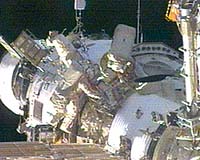
Moscow (AFP) Aug 19, 2005 Russian cosmonaut Sergei Krikalyov and US astronaut John Phillips completed a spacewalk out of the International Space Station (ISS) early on Friday devoted to maintenance tasks and returned safely inside the station, Russian mission control said. The two men returned to the station at 03:59 (2359 GMT Thursday), ending a spacewalk during which the ISS was left unmanned, the ITAR-TASS news agency quoted mission control spokesman Valery Lyndin as saying. The spacewalk lasted just under five hours, an hour short of the originally scheduled six hours, and the crew successfully completed almost all planned tasks, Lyndin said. "The task program was completed in its entirety, with the exception of the dismantling of an adaptor for the setting up of anti-meteorite shields," which was postponed to a later date, ITAR-TASS quoted Lyndin as saying. Among other tasks, Krikalyov and Phillips had been scheduled to set up an observation camera in view of the docking of new European cargo shuttle Jules Vernes, which is expected to be launched in the spring of next year, and to bring back on board a container that had been attached to the ISS' outer hull. Krikalyov Tuesday broke the record for the longest total time in space, with two months still left before returning to Earth. Krikalyov, who has been aboard the ISS since April 15, passed the record previously held by fellow-Russian Sergei Avdeyev, who spent a career total of 747 days, 14 hours, 14 minutes and 11 seconds in space. Community Email This Article Comment On This Article Related Links SpaceDaily Search SpaceDaily Subscribe To SpaceDaily Express Space Station News at Space-Travel.Com
 NASA Had No Choice But To Buy Soyuz Flights
 Washington DC (SPX) Jan 09, 2006
NASA's announcement last week that it will pay Roskosmos $43.6 million for a round-trip ride to the International Space Station this spring, and an equivalent figure for an as-yet-undetermined number of future flights to the station until 2012, represents the agency's acknowledgment that it had no alternative. |
|
|

| The content herein, unless otherwise known to be public domain, are Copyright 1995-2006 - SpaceDaily.AFP and UPI Wire Stories are copyright Agence France-Presse and United Press International. ESA PortalReports are copyright European Space Agency. All NASA sourced material is public domain. Additionalcopyrights may apply in whole or part to other bona fide parties. Advertising does not imply endorsement,agreement or approval of any opinions, statements or information provided by SpaceDaily on any Web page published or hosted by SpaceDaily. Privacy Statement |