|
 |
 |
 |
 |
 |
 |
 |
 |

 |
ISS Columbus Module Heads For Kennedy Space Center
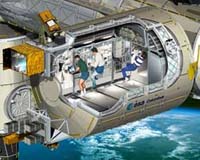
Kennedy Space Center FL (SPX) May 23, 2006 ESA's Columbus Laboratory module for the International Space Station has left its assembly site in Bremen, Germany, and is headed to the Space Station Processing Facility at Kennedy Space Center. As ESA's largest single contribution to the space station, the research laboratory module - comprising four payload facility racks - was completed in early May and delivered to the agency in a ceremony in Bremen, Germany. It now must be processed at Kennedy before being ferried to the station within the space shuttle's cargo bay. The physical design and layout of Columbus is not unlike the three multi-purpose logistics modules MPLM built by the Italian Space Agency and used for transporting scientific experiments, materials and supplies to the station via NASA shuttles. Unlike the visiting MPLMs, which return to Earth with the shuttles, Columbus will permanently expand the research facilities of the space station. The laboratory will be connected to the rest of the orbiting outpost by NASA's Node 2 module. Columbus is about 23 feet long and 15 feet wide, allowing it to hold 10 racks of experiments, each approximately the size of a phone booth. NASA will add five racks to the laboratory after it is mated to the station. Each rack provides independent controls for power and cooling, as well as communication links to earthbound controllers and researchers. These links will allow scientists all over Europe to participate in their own experiments in space from several user centers and, in some cases, even from their own work locations. The laboratory's flexibility provides room for researchers on the ground, aided by the station's crew, to conduct thousands of experiments in life sciences, materials sciences, fluid physics and other research in a weightless environment not possible on Earth. In addition, the station crew can conduct experiments outside the module within the vacuum of space, using four exterior mounting platforms that can accommodate external payloads. With a clear view of both Earth and space, external experiments can run the gamut from the microscopic world of bacteria to the limitlessness of space. The first two experiment packages will fly to the station on the shuttle with the module. The Columbus control center is located in Oberpfaffenhofen, Germany, from where ground controllers can communicate with the module as the space station orbits Earth, as well as with researchers across Europe and their partners in the United States and Russia. Columbus is expected to provide at least 10 years of science capabilities for researchers, both on Earth or aboard the station. Community Email This Article Comment On This Article Related Links Columbus at ESA Columbus at NASA Space Station News at Space-Travel.Com
 NASA Approves June 1 Spacewalk
 Houston TX (SPX) May 23, 2006
NASA announced Tuesday it has approved a June 1 spacewalk by the International Space Station crew, and the agency will broadcast the event live on NASA Television. |
|
|

| The content herein, unless otherwise known to be public domain, are Copyright 1995-2006 - SpaceDaily.AFP and UPI Wire Stories are copyright Agence France-Presse and United Press International. ESA PortalReports are copyright European Space Agency. All NASA sourced material is public domain. Additionalcopyrights may apply in whole or part to other bona fide parties. Advertising does not imply endorsement,agreement or approval of any opinions, statements or information provided by SpaceDaily on any Web page published or hosted by SpaceDaily. Privacy Statement |