|
 |
 |
 |
 |
 |
 |
 |
 |

 |
ISS Antenna Blocked Engine Hatch In Test Run
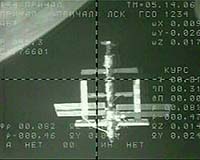
Moscow (RIA) Apr 28, 2006 A test run of one of the International Space Station's engines on April 20 failed when an antenna blocked the engine's hatch from opening fully, Mission Control said Thursday. Vladimir Solovyov, the head of the Russian segment of the world's sole orbital station, said there was no need to repeat the test, which would have shifted the station's orbit. "We docked the Progress M-56 freighter successfully on April 26, and for the moment there is no further need to correct the orbit," he said. The external antenna had been installed for communication between the ISS and the European-built Automated Transfer Vehicle (ATV), known as the Jules Verne. The ATV, currently at European Space Agency's test center in the Netherlands, will be used to transport provisions, scientific payloads and propellant to the station from 2008. Solovyov said, "At the launch of the 13th expedition of the Russian program scheduled for June 1-5, we will not attempt to move the hatch or reinstall the communications antenna at another place - the correcting engines of the station are in the long run not essential. "We have always made changes to the orbit using the engines of the Progress freighters docked to the ISS, and we will continue to do so."
Source: RIA Novosti Community Email This Article Comment On This Article Related Links Station at NASA Space Station News at Space-Travel.Com
 More Progress At Station By Late June
 Moscow (RIA) Apr 28, 2006
A Progress M-57 cargo rocket will be launched to the International Space Station between June 24 and 28, the head of the Russia's Energia space corporation said Thursday. |
|
|

| The content herein, unless otherwise known to be public domain, are Copyright 1995-2006 - SpaceDaily.AFP and UPI Wire Stories are copyright Agence France-Presse and United Press International. ESA PortalReports are copyright European Space Agency. All NASA sourced material is public domain. Additionalcopyrights may apply in whole or part to other bona fide parties. Advertising does not imply endorsement,agreement or approval of any opinions, statements or information provided by SpaceDaily on any Web page published or hosted by SpaceDaily. Privacy Statement |