|
 |
 |
 |
 |
 |
 |
 |
 |

 |
ISO Detects New Molecule In Space
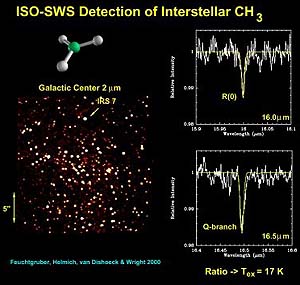
Paris - July 17, 2000 ESA's infrared space telescope has once again detected a new molecule in the 'chemistry labs' of the universe, the clouds of gas and dust in the space amid the stars. The newly-detected molecule is the methyl radical CH3, a so-called 'free-radical' whose existence in the gas in space had been predicted by Nobel winner Gerhard Herzberg, who died last year. ISO has already made the first detections in space of at least ten new molecules in the gas and solid-state phases. According to the authors -- from Germany, the Netherlands and Australia -- CH3 is one of the most important tracers for the formation of complex carbon-based molecules. The 'chemical cycle' of the universe begins in the stars, where a wealth of new chemical elements are produced in nuclear reactions. These elements combine in the surroundings of the stars to form various molecules, which in turn keep reacting as they travel through on interstellar space clumped in clouds of gas and dust. These so-called 'molecular clouds' work as space-chemistry laboratoriess; they close the cycle by contributing material to make new stars and planetary systems. Common molecules on Earth can therefore be common in space too, i.e. water, silicates or complex hydrocarbons -- molecules made of carbon and hydrogen. The new molecule detected by ISO, the methyl radical CH3, is an intermediate product in reactions leading to the production of hydrocarbons. On Earth, for instance, it intervenes in the synthesis of all petroleum derivatives -- which are hydrocarbons. CH3 is called a 'free radical' because of its extremely reactive nature: it combines very easily with other molecules, and in fact in the labs on Earth its study is very difficult because its lifetime is only a few millionths of a second. Herzberg got the Nobel Prize in Chemistry in 1971 for discovering the electronic structure and geometry of free radicals, including CH3. The methyl radical was detected by pointing ISO towards the centre of our Galaxy. The spectrometer SWS on board the satellite unambiguously identified the 'signature' of the free radical, coming from very cold and thin molecular clouds. Astronomers estimate that the gas in these clouds is at only -256 degrees Centigrade (17 deg Kelvin), and its density is very low: around one thousand molecules and atoms per cubic centimeter. Most of these are hydrogen -- only 13 molecules of CH3 per one thousand million molecules of hydrogen are detected, a clear demostration of the SWS sensitivity. These measurements provide the first estimates of the abundance of CH3 in space, which will also help to derive also the abundance of the larger hydrocarbon molecules.
More than expected "The unexpected amount of CH3 is a very important aspect. None of the models predict so much CH3. This comes indeed as a surprise, since these models reproduce very well the abundance of many other molecules. So, what is wrong? Are we missing some important aspect of the chemistry?", says Helmut Feuchtgruber, from the Max-Planck Institut f=FCr Extraterrestrische Physik and lead author of the discovery. Feuchtgruber underlines also "how thrilled Herzberg would have been with this detection". To experts in space chemistry this discovery confirms the key role ISO is playing in this field. ISO has observed a wealth of molecules in space, both in the gaseous and solid form, e.g. water, ices and crystalline silicates. The methyl radical CH3 itself was detected extraterrestrially for the first time by ISO on Saturn and Neptune in 1998 and 1999 respectively. To Feuchtgruber, "ISO's role in unveiling the chemical processes in space is unique. ISO spectrometers cover the important spectral range where the most abundant molecules have their infrared transitions. The fact that many molecules can be observed simultaneously with the same observatory, or even the same instrument, results in unprecedented accuracy of abundances for these molecules, and as a consequence the chemistry in space can be better understood. The unique sensitivity of the instruments allows also to detect minor species and species which cannot be detected because of the Earth's atmosphere, extending our knowledge about the processes and raising new puzzling questions". The first detection of the free radical CH3 in the interstellar space is reported in the paper by H. Feuchtgruber, F.P. Helmich, E.F. van Dishoeck and C.M. Wright, which appeared in 'The Astrophysical Journal, 535: L111-L114, 2000 June 1'. The paper is based on data from both spectrometers on board ISO, the Short Wavelength Spectrometer, SWS, and the Long Wavelength Spectrometer, LWS.
Email This Article Comment On This Article Related Links Space
 Satellite Launch To Boost DTH In India
 Calcutta, India (SPX) Dec 28, 2005
The successful launch Thursday of India's heaviest satellite from spaceport of Kourou in French Guyana may have boosted the country's space research efforts to yet another level, but it has also lifted the spirits of at least three Direct-To-Home televisions broadcasters, one of which has been waiting for years to launch its services in India.
--------------------------------------------------------- It's new. And it's downright terrific! Celestron's CPC Schmidt-Cassegrain telescope is the scope you've been waiting for! It offers new alignment technology, advanced engineering, and bold new design at a new, low price! In fact, Celestron's Professional Computerized (CPC) scope with revolutionary SkyAlign Alignment Technology redefines everything that amateur astronomers are looking for. It offers quick and simple alignment, GPS technology, unsurpassed optical quality, ease of use, advanced ergonomics, enhanced computerization and, most important, affordability. Want to view M-31 tonight? One button takes you there!
Shop for telescopes online at Telescopes.com! today!
|
|
|

|
|
|
|
|
|
|
|
|
|
|
|
| The content herein, unless otherwise known to be public domain, are Copyright 1995-2006 - SpaceDaily.AFP and UPI Wire Stories are copyright Agence France-Presse and United Press International. ESA PortalReports are copyright European Space Agency. All NASA sourced material is public domain. Additionalcopyrights may apply in whole or part to other bona fide parties. Advertising does not imply endorsement,agreement or approval of any opinions, statements or information provided by SpaceDaily on any Web page published or hosted by SpaceDaily. Privacy Statement |