|
 |
 |
 |
 |
 |
 |
 |
 |

 |
ILS to Launch Inmarsat Satellite On Proton Vehicle Next Spring
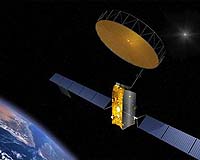
McLean VA (SPX) Aug 08, 2007 International Launch Services (ILS) and Inmarsat announced a contract for launch of the Inmarsat 4-F3 satellite on a Proton Breeze M vehicle in early 2008. This satellite, third in the constellation, will enable Inmarsat to offer global coverage with its BGAN mobile broadband service, as well as existing services. Launch from the Baikonur Cosmodrome in Kazakhstan is planned for the March-April time period. Financial terms were not disclosed. ILS will provide an enhanced version of its Proton Breeze M vehicle, which is built by Khrunichev State Research and Production Space Center of Moscow. The Enhanced Proton has the capability to lift payloads exceeding 6 metric tons. The F3 satellite, weighing more than 5900 kg, will be one of the heaviest commercial payloads to date for Proton. The Inmarsat 4 series of satellites are Eurostar E3000 models built by Astrium, among the most sophisticated commercial satellites ever launched and 60 times more powerful than their predecessors. ILS President Frank McKenna noted that the Proton demonstrated its enhanced capabilities a month ago with the successful launch of DIRECTV 10, which is similar in mass to the Inmarsat F4 satellite. "Enhanced Proton performed as anticipated, and fits well with Inmarsat's requirements," McKenna said. "We understand how important it is for Inmarsat to complete its BGAN expansion in a timely fashion, and we are focusing on performance to meet Inmarsat's schedule demands for a launch of F4 in the first quarter of 2008." Andrew Sukawaty, chairman and CEO, Inmarsat Plc, said: "In response to the growth we are seeing from our maritime, aero and new BGAN customers we are pleased to announce the signing of this contract with ILS. This will allow us to take the global services that are standard for Inmarsat into the new fleet of Inmarsat 4's. We will now have global coverage for all services in the future." The Proton enhancements are the result of more than two years of research, development and testing by Khrunichev, which is a partner in the ILS joint venture. While the primary purpose of the upgrades was to meet the requirements of ILS commercial customers and their larger satellites, the enhanced vehicle will ultimately be used for Russian federal missions as well.
Voice and broadband Three Inmarsat-4 satellites were built for Inmarsat by EADS Astrium. The first in the series, I-4 F1, was launched in March 2005, and has an orbital slot over the Indian Ocean at 64 degrees east. The second, I-4 F2, was launched in November 2005, and provides coverage for the Americas from an orbital slot at 154 degrees west. The I-4 F3 was a ground spare for the two launches in 2005, but its launch and orbital position will complete the Inmarsat-4 constellation and support the global delivery of Inmarsat's latest services.
Global coverage "The third satellite will provide global coverage for our existing BGAN service and will benefit our new broadband maritime and aeronautical services as well as our global satellite phone service. "This will provide incremental opportunities for growth in our maritime and aeronautical markets." Community Email This Article Comment On This Article Related Links International Launch Services (ILS) Inmarsat Launch Pad at Space-Travel.com
 A Double Transfer At The Spaceport For The Next Two Ariane 5 Launchers
 Kourou, French Guiana (SPX) Aug 02, 2007
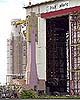
The Ariane 5 ECA for Arianespace's upcoming heavy-lift flight has been transferred to the Final Assembly Building at Europe's Spaceport, where the vehicle will be fitted with its dual satellite payload. This rollout marked a new milestone in preparations for the August 14 mission, and also underscored the flexibility of Ariane 5's launch infrastructure at the Spaceport in French Guiana. The next flight will be Arianespace's third Ariane 5 mission of 2007, and is to carry the BSAT-3a and SPACEWAY 3 spacecraft. |
|
|

| The content herein, unless otherwise known to be public domain, are Copyright 1995-2007 - SpaceDaily.AFP and UPI Wire Stories are copyright Agence France-Presse and United Press International. ESA Portal Reports are copyright European Space Agency. All NASA sourced material is public domain. Additional copyrights may apply in whole or part to other bona fide parties. Advertising does not imply endorsement,agreement or approval of any opinions, statements or information provided by SpaceDaily on any Web page published or hosted by SpaceDaily. Privacy Statement |