
 |
 |
 |
 |
 |
 |
 |
 |
 |

 |
IBEX Spacecraft Takes Major Step Toward Launch
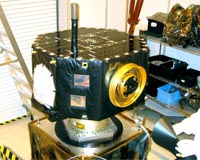
Greenbelt MD (SPX) Jul 28, 2008 NASA's Interstellar Boundary Explorer (IBEX) spacecraft, designed to image global interactions at the outer reaches of the solar system, has began its move to Vandenberg Air Force Base (VAFB), Calif. The IBEX spacecraft was loaded into a truck at Orbital Sciences Corporation, Va., where engineers integrated the science payload with the spacecraft and completed numerous tests to ensure optimum performance during the launch and operational phases of the mission. "This is a huge milestone for the IBEX mission. It's great to have our spacecraft making its road trip west," said Dr. David McComas, IBEX principal investigator and senior executive director of the Space Science and Engineering Division at Southwest Research Institute. "At Vandenberg, IBEX will undergo some final testing, fueling, and spin balancing prior to being mated to a Pegasus launch vehicle." IBEX will move once more before its scheduled October 5 launch. In late September, the spacecraft will be transported to a facility on Kwajalein Island, a part of the Marshall Islands, roughly equidistant between Hawaii, Japan and Australia. There it will undergo final preparations for its unique launch. An L-1011 aircraft is set to carry IBEX and the Pegasus rocket out over the South Pacific, fly toward the east, and drop it. Shortly after drop, the rocket will ignite and carry IBEX up to about 130 miles above Earth, spin it up to 60 RPM, and release it. "This move to VAFB begins the final sequence of ground processing for the IBEX mission," said Greg Frazier, IBEX Mission Manager. "We are all looking forward to completing the ground processing, integrating with the Pegasus launch vehicle and having a successful launch." Using a concept never before attempted, the IBEX team integrated its own additional solid rocket motor and internal propulsion system to transport the spacecraft all the way up to its final high-altitude orbit (about 200,000 miles high) - most of the way to the Moon. This groundbreaking, relatively inexpensive launch method holds great promise for delivering future small government and commercial spacecraft to high-altitude orbits. During its science investigation, IBEX will use a pair of energetic neutral atom "cameras" to image interactions between the million mile-per-hour solar wind continually blown out by the Sun and the low-density material between the stars, known as the interstellar medium - interactions never before imaged. The spacecraft begins imaging the edge of the solar system within a couple of weeks after it reaches final orbit. Every six months, the spacecraft will complete an all-sky map of the interstellar boundaries, expected to reveal much about our home in the galaxy. "The IBEX mission will provide a much deeper understanding of the Sun's interaction with the galaxy and will also address a serious challenge facing manned exploration by studying the region that shields us from the majority of galactic cosmic ray radiation," said McComas. IBEX is the next in NASA's series of low-cost, rapidly developed Small Explorers spacecraft. The IBEX mission was developed by Southwest Research Institute with a national and international team of partners. NASA's Goddard Space Flight Center manages the Explorers Program for the Science Mission Directorate. Community Email This Article Comment On This Article Share This Article With Planet Earth
Related Links IBEX mission Launch Pad at Space-Travel.com
 Soyuz-ST To Be Launched From French Guiana In First Half Of 2009
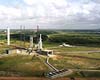 Moscow (RIA Novosti) Jul 24, 2008
The first Soyuz-ST carrier rocket will be launched from French Guiana in the first half of 2009, the Russian Space Agency Roscosmos said on Wednesday, citing the French satellite launch firm Arianespace CEO. |
|
|

| The content herein, unless otherwise known to be public domain, are Copyright 1995-2007 - SpaceDaily.AFP and UPI Wire Stories are copyright Agence France-Presse and United Press International. ESA Portal Reports are copyright European Space Agency. All NASA sourced material is public domain. Additional copyrights may apply in whole or part to other bona fide parties. Advertising does not imply endorsement,agreement or approval of any opinions, statements or information provided by SpaceDaily on any Web page published or hosted by SpaceDaily. Privacy Statement |
 del.icio.us
 Digg
Digg Reddit
 YahooMyWeb
 Google
 Facebook