
 |
 |
 |
 |
 |
 |
 |
 |
 |

 |
IBEX Satellite Ready For Integration With Pegasus Launch Vehicle
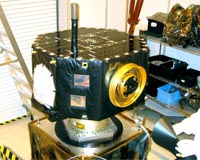
Dulles VA (SPX) Jul 31, 2008 Orbital Sciences has announced that the Interstellar Boundary Explorer (IBEX) satellite has arrived at Vandenberg Air Force Base (VAFB), CA following the completion of its manufacturing, integration and testing activities at Orbital's facilities in Dulles, VA. The satellite arrived at VAFB on Monday, July 28 to begin the integration process with the Pegasus launch vehicle that will launch it into orbit, which is currently scheduled to take place in early October. The IBEX satellite project is led by Dr. David McComas, the mission's Principal Investigator from the Southwest Research Institute (SwRI). The IBEX space science satellite is part of NASA's Small Explorers (SMEX) program that is managed by the Goddard Space Flight Center for NASA's Science Mission Directorate. Orbital and SwRI are also partnered on The Great Escape (TGE), one of the two finalists for the next Mars Scout mission to be carried out by NASA, which is based on Orbital's successful Dawn spacecraft platform. During its science investigation, IBEX will use a pair of energetic neutral atom "cameras" to capture never-before-seen images of the interactions between the million mile-per-hour solar wind that is continually blown out by the Sun and the low-density material between the stars known as the interstellar medium. To capture the images, IBEX must reach a highly elliptical orbit that will reach approximately 60% of the way to the Moon at its apogee to perform its measurements, a feat never before performed with a low-cost space mission. "The arrival of the IBEX spacecraft at Orbital's Vandenberg facilities is a huge milestone for our mission, since it represents the first leg of its journey into space," said Dr. McComas, IBEX Principal Investigator and Senior Executive Director of the Space Science and Engineering Division at Southwest Research Institute. "The IBEX mission will provide a much deeper understanding of the Sun's interaction with the galaxy and will also address a serious challenge facing manned exploration by studying the region that shields us from the majority of galactic cosmic ray radiation," Dr. McComas concluded. The next leg of the IBEX satellite's journey will take place in late September when the combined Pegasus air-launch system and the attached spacecraft will be ferried by Orbital's L-1011 carrier aircraft to Kwajalein Island, a part of the Marshall Islands in the mid-Pacific Ocean, roughly equidistant between Hawaii, Japan and Australia. Orbital has successfully supported many other science missions for NASA in the past, as both the spacecraft and launch vehicle provider, including SORCE and ACRIMSAT, and the two most recent SMEX missions, GALEX and AIM. Orbital is also currently completing the Orbiting Carbon Observatory and Glory missions for NASA and was recently selected as the spacecraft provider for the latest SMEX mission, NuSTAR. Mr. Michael Larkin, Orbital's Executive Vice President and General Manager of its Space Systems Group, said, "The IBEX mission continues Orbital's support for important NASA science missions and illustrates the effective partnership we have established between NASA, SwRI and Orbital. We look forward to the exciting science data which IBEX will provide." Community Email This Article Comment On This Article Share This Article With Planet Earth
Related Links Launch Pad at Space-Travel.com
 Success Of The 1734th launch Of Soyuz
 Kourou, French Guiana (SPX) Jul 28, 2008
The 1734th flight of a Soyuz launch vehicle was performed Saturday, July 26, 2008 from the Plesetsk Cosmodrome in Russia at 10:31 pm Moscow time (08:21 pm Paris time). |
|
|

| The content herein, unless otherwise known to be public domain, are Copyright 1995-2007 - SpaceDaily.AFP and UPI Wire Stories are copyright Agence France-Presse and United Press International. ESA Portal Reports are copyright European Space Agency. All NASA sourced material is public domain. Additional copyrights may apply in whole or part to other bona fide parties. Advertising does not imply endorsement,agreement or approval of any opinions, statements or information provided by SpaceDaily on any Web page published or hosted by SpaceDaily. Privacy Statement |
 del.icio.us
 Digg
Digg Reddit
 YahooMyWeb
 Google
 Facebook