|
 |
 |
 |
 |
 |
 |
 |
 |

 |
IAU Approves Names For Two Small Plutonian Moons
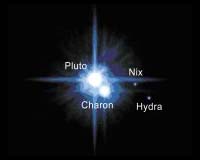
Boulder CO (SPX) Jun 22, 2006 The International Astronomical Union announced Thursday it has approved the names Nix and Hydra for the two small satellites of Pluto discovered in May 2005. The IAU, the only internationally recognized authority for assigning designations to celestial bodies, approved the names this week. Nix and Hydra, roughly 5,000 times fainter than Pluto itself, are about two to three times as far from Pluto as its large moon, Charon, which was discovered in 1978. The nine-member discovery team selected the name Nyx for S/2005 P 2, the inner small satellite, and the name Hydra for S/2005 P 1, the outer small satellite. Because asteroid 3908 already bears the Greek name Nyx, the IAU changed Nyx to its Egyptian equivalent, Nix. In mythology, Nix is the goddess of darkness and night, befitting a satellite orbiting distant Pluto, the god of the underworld. Nix is also the mother of Charon, relevant to the giant impact believed to have created Pluto's three satellites, indicating Charon was borne of the material from which Nix formed. Hydra is the terrifying monster with the body of a serpent and nine heads, befitting the outermost moon of Pluto, the ninth planet in the solar system. A team of researchers from Southwest Research Institute, the Johns Hopkins University Applied Physics Laboratory in Laurel, Md., the Space Telescope Science Institute in Baltimore, Md., and the Lowell Observatory in Flagstaff, Ariz., used Hubble Space Telescope images to make the discovery in support of NASA's New Horizons mission to Pluto and the Kuiper Belt beyond. "We're very pleased with the decision of the IAU," said co-leader of the discovery team and New Horizons Principal Investigator Alan Stern of SwRI. "You're going to be hearing a lot more about Nix and Hydra in coming years - astronomers are already applying for telescope time to study their orbits and physical properties. And when New Horizons flies by Pluto in the summer of 2015, each will be mapped in detail." "Pluto doesn't reveal its moons easily," adds team co-leader and New Horizons Project Scientist Hal Weaver of APL. "It took 48 years after the discovery of Pluto to find Charon and another 27 years to find Nix and Hydra. Perhaps we won't have to wait as long for the next discovery because the New Horizons spacecraft will be making a rendezvous with Pluto in nine years and will be searching for other small satellites." Just as Pluto's name begins with the letters "P" and "L" to honor Percival Lowell, who motivated the search that led to its discovery, Nix and Hydra honor the search for new satellites and the New Horizons mission to Pluto by starting with the letters "N" and "H." The first letter of Hydra also honors the Hubble Space Telescope that was used to detect the satellites. Community Email This Article Comment On This Article Related Links Southwest Research Institute The million outer planets of a star called Sol
 Three Trojan Asteroids Share Neptune Orbit
 Washington DC (SPX) Jun 16, 2006
Researchers announced Thursday they have found three new objects locked into roughly the same orbit as Neptune. The objects - called Trojan asteroids - were found by researchers from the Carnegie Institution's Department of Terrestrial Magnetism and the Gemini Observatory in Hilo, Hawaii. |
|
|

| The content herein, unless otherwise known to be public domain, are Copyright 1995-2006 - SpaceDaily.AFP and UPI Wire Stories are copyright Agence France-Presse and United Press International. ESA PortalReports are copyright European Space Agency. All NASA sourced material is public domain. Additionalcopyrights may apply in whole or part to other bona fide parties. Advertising does not imply endorsement,agreement or approval of any opinions, statements or information provided by SpaceDaily on any Web page published or hosted by SpaceDaily. Privacy Statement |