|
 |
 |
 |
 |
 |
 |
 |
 |

 |
Hydrogel Particles Pave Way For New Bedside Diagnostics
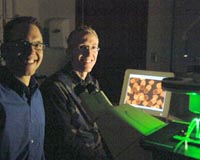
Boston MA (SPX) Mar 13, 2007 MIT researchers have created an inexpensive method to screen for millions of different biomolecules (DNA, proteins, etc.) in a single sample--a technology that could make possible the development of low-cost clinical bedside diagnostics. The work, based on tiny customizable particles, could also be used for disease monitoring, drug discovery or genetic profiling. Even though the particles are thinner than the width of a human hair, each is equipped with a barcoded ID and one or more probe regions that turn fluorescent when they detect specific targets in a test sample. Using a new, extremely versatile technique, the researchers can produce a "virtually unlimited" array of particles to test for DNA, RNA, proteins and other biomolecules, said Daniel Pregibon, a graduate student in chemical engineering at MIT. Pregibon is the lead author of a paper on the work that will appear in the March 9 issue of Science. He and co-author Patrick Doyle, the Doherty Associate Professor of Chemical Engineering, believe their particles could become an effective and inexpensive way to perform medical diagnostic tests at a patient's bedside. Current testing methods are cost-prohibitive for bedside use, Pregibon said. The MIT particles are inexpensive to manufacture, and their results are as accurate, if not more so, than the results from more expensive systems, he said. The particles offer a new way to do "multiplexed detection"--testing a single sample for multiple targets. In the laboratory, a common (but expensive) multiplexing technique involves a planar microarray--a flat surface with many spotted probes that each test for different targets. The MIT researchers are taking this approach away from planar surfaces onto free-floating particles. With the tiny particles, it is much easier to custom-design each biological test, said Doyle. "It's very easy to tailor what you give a customer. You could have 100 types of particles and mix them together," he said. The researchers' particle fabrication method gives them exquisite control over the particles' shape and chemical characteristics. As two streams of monomers (liquid precursors loaded with fluorescent dye or molecular probe) flow side by side through a microfluidic device, ultraviolet light repeatedly strikes the streams. A chemical reaction initiated by the light causes the liquid to solidify, forming a single particle with two distinct ends. Each particle takes on the shape of a "mask" (similar to a transparency film) through which the UV light is aimed. One end of each particle is a fluorescent "dot-pattern" barcode that reveals what the target molecule of the particle is, and the other end is loaded with a probe and only turns fluorescent if the target molecule is present. The particles can also be designed to each test for multiple targets, by adding several unique regions. "We can make the particles, encode them and add functionality all in a single step," said Pregibon. When a mixture of particles is added to a test sample, target molecules (DNA, proteins, etc.) will bind to the region of the particles containing the corresponding probe. This interaction can be detected by fluorescence, which is brighter when more of the target is present. To rapidly "read" the particles, the researchers designed a custom "flow cytometer" using a microfluidic device and standard microscope. In this flow-through system, the oblong, disk-like shape of the particles ensures that they are precisely aligned for accurate scanning. Each time a particle flows past a detector, its barcode is read and the corresponding target is quantified. The microparticles are inexpensive because they can be produced efficiently in a single step. The design of the particles also makes the scanning devices cheaper. With multiple distinct regions, the barcode can be read and the target quantified using a single fluorescent color, which greatly simplifies detection. The particles are also unique in that they are made of a spongy polymer "hydrogel" called poly(ethylene glycol). That polymer enhances the sensitivity of the test because it is porous, allowing the target molecules to diffuse into it. For the Science paper, the researchers created particles with DNA probes attached at one end. They demonstrated that the particles could accurately and reproducibly detect the presence of multiple target DNA sequences, and they anticipate similar results with RNA, proteins and cytokines. The researchers are focusing on bedside diagnostics and "theranostics"--the emerging concept of providing personalized diagnostic therapy. This method for tailoring therapies to each patient could be a breakthrough for treating diseases like cancer and cardiovascular disease. The particles could also be used to genetically profile individual patients and screen for bioterrorism or other hazardous environmental agents. Mehmet Toner, a professor of surgery at Harvard Medical School, is also an author on the Science paper. The research was funded by the National Science Foundation and the Dumbros Fellowship. Community Email This Article Comment On This Article Related Links MIT Hospital and Medical News at InternDaily.com Hospital and Medical News at InternDaily.com
 Hospital Equipment Unaffected By Cell Phone Use
 Rochester MN (SPX) Mar 09, 2007
Calls made on cellular phones have no negative impact on hospital medical devices, dispelling the long-held notion that they are unsafe to use in health care facilities, according to Mayo Clinic researchers. In a study published in the March issue of Mayo Clinic Proceedings, researchers say normal use of cell phones results in no noticeable interference with patient care equipment. Three hundred tests were performed over a five-month period in 2006, without a single problem incurred. |
|
|

| The content herein, unless otherwise known to be public domain, are Copyright 1995-2006 - SpaceDaily.AFP and UPI Wire Stories are copyright Agence France-Presse and United Press International. ESA PortalReports are copyright European Space Agency. All NASA sourced material is public domain. Additionalcopyrights may apply in whole or part to other bona fide parties. Advertising does not imply endorsement,agreement or approval of any opinions, statements or information provided by SpaceDaily on any Web page published or hosted by SpaceDaily. Privacy Statement |