|
 |
 |
 |
 |
 |
 |
 |
 |

 |
Hybrid welding process developed
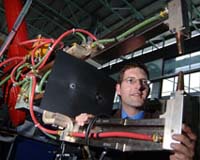
Oak Ridge, Tenn. (UPI) Dec 18, 2006 U.S. scientists say they've developed a hybrid process involving the use of a laser in friction-stir welding to extend the application to more materials. FSW, which has been in development for about 10 years, is a technique for joining small metal alloys using a rotating tool to fasten metal components without melting. The process is best suited for alloys with low melting points, such as aluminum, and materials that are difficult to weld with conventional methods. However, extending FSW to high-temperature metals and alloys such as steel and titanium has been problematic because of tool wear and material requirements. Scientists at the Oak Ridge National Laboratory say adding a laser to the FSW process to preheat and soften the metal parts reduces wear on the tool. The researchers say the hybrid laser-assisted FSW technology will enable the industrial application of FSW to joining high-temperature metals and alloys. The U.S. Department of Energy's Office of Basic Energy Sciences, Energy Efficiency and Renewable Energy and Fusion Materials fund the work. Community Email This Article Comment On This Article Related Links Space Technology News - Applications and Research
 Scientists study liquid crystal properties
 Kent, Ohio (UPI) Dec 18, 2006
 U.S. scientists say changing the size of colloids -- micro- or nanometer-sized particles -- makes a big difference in the properties of liquid crystals. |
|
|

| The content herein, unless otherwise known to be public domain, are Copyright 1995-2006 - SpaceDaily.AFP and UPI Wire Stories are copyright Agence France-Presse and United Press International. ESA PortalReports are copyright European Space Agency. All NASA sourced material is public domain. Additionalcopyrights may apply in whole or part to other bona fide parties. Advertising does not imply endorsement,agreement or approval of any opinions, statements or information provided by SpaceDaily on any Web page published or hosted by SpaceDaily. Privacy Statement |