|
 |
 |
 |
 |
 |
 |
 |
 |

 |
Hurricanes Could Be Just As Bad Next Year: US Experts
Miami (AFP) Nov 29, 2005 Marking the conclusion of the busiest Atlantic hurricane season on record, US experts warned Tuesday that next year could be just as bad. "I'd like to foretell that next year will be calmer, but I can't," said Conrad Lautenbacher, who heads the National Oceanic and Atmospheric Administration. "Historical trends say the atmosphere patterns and water temperatures are likely to force another active season upon us," he said at a news conference. hurricane hyperactivity could continue in the Atlantic basin for years to come, the experts said. "Because we are in an active era, it's important to recognize that with a greater number of hurricanes come increasing odds of one striking land," National Weather Service Director David Johnson. As he spoke, the National hurricane Center (NHC) announced the formation in the mid-Atlantic of Tropical Storm Epsilon, indicating the record-breaking six-month season was now likely to extend beyond its official end on Wednesday. Of the record 26 tropical storms that formed over the Atlantic since the season started on June 1, an unprecedented 13 became hurricanes. Another record was set with three of the hurricanes ranking at category five, the highest on the Saffir-Simpson intensity scale. "This year's season was indeed unprecedented, it's been six long months, said Lautenbacher, a retired US Navy vice admiral. Max Mayfield, who heads the Miami-based NHC warned residents in hurricane-prone areas to get ready now for next year's battle against the elements. "Everybody needs a plan," Mayfield said in Miami.
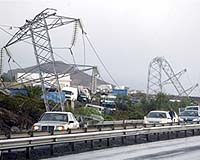
Busiest Atlantic hurricane season on record comes to an end by Patrick Moser Residents along the hurricane belt heaved a sigh of relief as the threat fizzled away for now, but scientists warned that coming years could be just as intense. Several grim records were set during the six-month season, which officially ends on November 30. Katrina, which killed more than 1,200 people in New Orleans and other US Gulf coast areas in August, was the most expensive US hurricane and one of the deadliest. But it was just one of a record 13 Atlantic hurricanes this year. hurricane Wilma, which slammed into Florida in October, became the most intense hurricane ever in the Atlantic, with its central pressure falling to 882 millibars. In all, an unprecedented 25 tropical storms raged in the Atlantic Basin since the season started on June 1. The previous busiest Atlantic hurricane season on record was in 1933, with 21 storms. The death and destruction the storms wrought along the Caribbean, on the shores of the Gulf of Mexico and on Florida's Atlantic coast are still evident in many areas. In New Orleans, entire neighborhoods remain deserted, including the hardest-hit Ninth Ward which is scheduled to reopen on December 1. Friends, relatives and even insurance inspectors are still finding bodies trapped in attics and collapsed buildings. Much of the devastation in New Orleans was caused by floodwaters after Katrina's wrath shattered levees in the famed, low-lying city. Just as workers finished pumping out the floodwater, hurricane Rita caused renewed flooding in the "Big Easy" in October. That same month, Stan devastated Guatemala, even though it had weakened from a hurricane to a tropical storm by the time it hit the impoverished central American nation. Flashfloods and mudslides left about 2,000 people feared dead, destroyed crops, killed cattle and cut off an entire province. Last year's Atlantic season already had been particularly busy and damaging, and forecasters believe this is part of period of intense hurricane activity in the Atlantic Basin. Several experts say the hyperactivity is likely to continue for several years, as part of what they see as a historic cycle where busy hurricane periods alternate with decades of relative calm. "In the 1970's, there was an average of about 10 Category four and five hurricanes per year globally. Since 1990, the number of Category four and five hurricanes has almost doubled, averaging 18 per year globally," said Peter Webster, an expert at the Georgia Institute of Technology. hurricanes that rank at category four on the Saffir-Simpson intensity scale have sustained winds of between 210 and 249 kilometers (131 to 155 miles) per hour, and category five -- the highest -- has winds of above 249 kilometers (155 miles) per hour. There are strong fears that global warming caused by emissions of greenhouse gasses is further fueling the deadly weather systems by increasing sea surface temperatures, though the theory remains controversial. While experts disagree on whether global warming is to blame for more frequent and more intense hurricanes, most agree the risk posed by the deadly storms increases as US coastal areas become more densely populated. "The large upward surge in hurricane damage in the US, is clearly owing to the confluence of rapidly increasing coastal population with a decadal time-scale upswing in Atlantic hurricane activity," said Kerry Emanuel, a professor of atmospheric science at the Massachussetts Institute of Technology. Community Email This Article Comment On This Article Related Links SpaceDaily Search SpaceDaily Subscribe To SpaceDaily Express Bringing Order To A World Of Disasters When the Earth Quakes A world of storm and tempest
 New Orleans Colleges To Reopen This Week
 New Orleans, Louisiana (AFP) Jan 05, 2006
Thousands of students and faculty are returning to New Orleans' eight colleges and universities this week for the first time since hurricane Katrina flooded the city four months ago. |
|
|

| The content herein, unless otherwise known to be public domain, are Copyright 1995-2006 - SpaceDaily.AFP and UPI Wire Stories are copyright Agence France-Presse and United Press International. ESA PortalReports are copyright European Space Agency. All NASA sourced material is public domain. Additionalcopyrights may apply in whole or part to other bona fide parties. Advertising does not imply endorsement,agreement or approval of any opinions, statements or information provided by SpaceDaily on any Web page published or hosted by SpaceDaily. Privacy Statement |