|
 |
 |
 |
 |
 |
 |
 |
 |

 |
Hurricane Intensity Predictions Take Into Account Effect Of Large Eddies
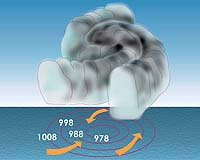
Kingston RI (SPX) Jan 11, 2005 The combined Geophysical Fluid Dynamics Laboratory/University of Rhode Island coupled hurricane-ocean model has helped to improve intensity predictions during tropical storms. However, scientists have found that the model consistently under-predicts maximum wind speed in very strong hurricanes. In the current issue of the Journal of the Atmospheric Sciences, University of Rhode Island physical oceanographer Dr. Isaac Ginis describes how he and a team of scientists are refining the model by incorporating the factors that favor the formation of large eddies near the sea surface and their effect on wind speed and air humidity. Other members of the team include Alexander P. Khain and Elena Morozovsky of the Institute of Earth Sciences, Hebrew University of Jerusalem, Israel. The authors speculate large eddies, or circular currents of air, are a pervasive feature in tropical cyclones and suggests that they can contribute significantly to the transfer of energy, heat, and moisture from the ocean to the atmosphere. "Lack of adequate consideration of the large eddy effects near the surface of the ocean may be one of the reasons for the limited tropical cyclone intensity forecast skill by hurricane prediction models," said Ginis. "The recently implemented to operational Geophysical Fluid Dynamics Laboratory (GFDL)/ University of Rhode Island (URI) coupled hurricane-ocean model helped to improve the intensity predictions measured by the central pressure." "However, it has not always translated into improvements in predicting maximum wind speed. This is mainly due to underestimations of the surface winds in strong tropical cyclones." In strong wind conditions the GFDL/URI model tends to underpredict surface wind speeds for a given central pressure. It is most likely the result of inadequate representation of the physical processes connected with the storm, in particular the contribution of large eddies in the modeling of the area near the sea surface and how the atmosphere and ocean interact. The main objective in the study was to investigate the mechanisms leading to the formation of large eddies under tropical cyclone conditions and assess their effects on the factors that determine a storm's intensity using a high-resolution, atmospheric computer model. Ginis, Khain, and Morozovsky presented a new method to describe large eddies in both general circulation and regional weather prediction models, including hurricane models. Their approach is called "superparameterization," which consists of an eddy-resolving, two-dimensional system embedded into a weather prediction model, allowing explicit simulations of large eddies. Based on the results of their numerical simulations, the scientists found that when the wind speed is high enough, a strong vertical wind shear that develops near the sea surface triggers conditions that allow for genesis of large eddies. They concluded that a strong background wind, typical for hurricanes, and evaporation from the ocean are the necessary conditions for the formation of large eddies in the lower part of the atmosphere. The experiments demonstrated that as soon as large eddies arise, they affect the transport of heat, moisture, and momentum, modifying the structure of the atmosphere and the way it interacts with the ocean. The most significant manifestation of these effects is a significant increase of the near-surface wind speed, and evaporation from the sea surface, which can double in strong winds. "These results demonstrate the important role that large eddies play in high wind speed conditions," said Ginis. "Inclusion of these effects in the tropical cyclone models may potentially lead to substantial improvements in the prediction of storm intensity." Ginis's work on this project was partially supported by the National Science Foundation. Khain and Morozovsky were supported by the Lady Davis Foundation and the U.S.-Israel Binational Science Foundation. Community Email This Article Comment On This Article Related Links University of Rhode Island Geophysical Fluid Dynamics Laboratory SpaceDaily Search SpaceDaily Subscribe To SpaceDaily Express Weather News at TerraDaily.com
 UN Launches World's Largest Program To Fight Desertification In Africa
 Nairobi (AFP) Oct 24, 2005
The United Nations and international lenders on Monday launched a multi-billion-dollar initiative to fight desertification in Africa, billed as the world's largest scheme to prevent land degradation. |
|
|

| The content herein, unless otherwise known to be public domain, are Copyright 1995-2006 - SpaceDaily.AFP and UPI Wire Stories are copyright Agence France-Presse and United Press International. ESA PortalReports are copyright European Space Agency. All NASA sourced material is public domain. Additionalcopyrights may apply in whole or part to other bona fide parties. Advertising does not imply endorsement,agreement or approval of any opinions, statements or information provided by SpaceDaily on any Web page published or hosted by SpaceDaily. Privacy Statement |