|
 |
 |
 |
 |
 |
 |
 |
 |

 |
Humans Show Innate Ability To Detect The Snake In The Grass
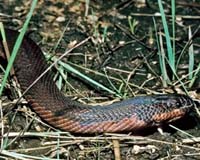
Washington DC (SPX) Mar 04, 2008 Adults and very young children apparently have an innate ability to very quickly detect the presence of a snake from among a variety of non-threatening objects and creatures such as a caterpillar, flower or toad, according to a new study by psychologists at the University of Virginia. The study appears in the March 2008 issue of the journal Psychological Science. The paper is available for download here in pdf format. "Our finding matches with the evolutionary theory that humans have a pre-disposition to quickly identify a snake," says Vanessa LoBue, a post-doctoral fellow in psychology at U.Va. "Throughout the course of human evolution, humans who could quickly visually detect the presence of snakes were able to survive and reproduce, thereby passing this capability on in the gene pool." LoBue and her colleague Judy DeLoache, a U.Va. professor of psychology, showed three-year-old children and adults photographs of snakes and various flora and fauna on a touch-screen monitor to see how quickly they could distinguish the snake or snakes from the other creatures or natural objects. They found that both children and adults were very good at nearly immediately identifying a snake from among the non-threatening images, but clearly not as good at finding a non-threatening image from among several snake photographs. "Unlike adults, three-year-old children don't have much experience with snakes - particularly negative experiences - but they can detect snakes very quickly, much more quickly than non-threatening objects," LoBue notes. She and DeLoache also found that both children and adults who don't fear snakes are just as good at quickly identifying them as children and adults who do fear snakes, indicating that there may be a universal human ability to visually detect snakes whether there is or is not a fear factor based on a learned bias or experience. LoBue and DeLoache emphasize that their study does not prove an innate fear of snakes, only that humans, including young children, seem to have an innate ability to quickly identify a snake from among other things. One of their previous studies indicated that humans also have a profound ability to identify spiders from among non-threatening flora and fauna. Lobue has also shown that people are very good at quickly detecting threats of many types, including aggressive facial expressions. DeLoache and colleagues in her lab specialize in understanding cognitive development and how people, particularly children, process symbols. Community Email This Article Comment On This Article Related Links All About Human Beings and How We Got To Be Here
 Culture-shaping elite go to TED for mind-bending inspiration
 Monterey, California (AFP) March 2, 2008
Comedian Robin Williams scrutinizes grim images of abuses perpetuated by US soldier guards at Abu Ghraib prison in Iraq. |
|
|

| The content herein, unless otherwise known to be public domain, are Copyright 1995-2007 - SpaceDaily.AFP and UPI Wire Stories are copyright Agence France-Presse and United Press International. ESA Portal Reports are copyright European Space Agency. All NASA sourced material is public domain. Additional copyrights may apply in whole or part to other bona fide parties. Advertising does not imply endorsement,agreement or approval of any opinions, statements or information provided by SpaceDaily on any Web page published or hosted by SpaceDaily. Privacy Statement |