|
 |
 |
 |
 |
 |
 |
 |
 |

 |
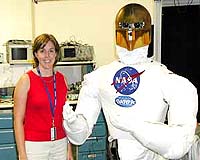
Humanities, engineering contribute expertise in developing NASA's Robonaut
Houston - Dec 08, 2003 Everyone could use an extra set of hands every now and then, and if two Rice researchers and a crack team of scientists at NASA's Johnson Space Center (JSC) have their way, astronauts aboard the International Space Station just might get their extra set. NASA's Robonaut project aims to create a humanoid robot to function as a second set of eyes, arms and hands on spacewalks. Two Rice assistant professors -- Marcia O'Malley of mechanical engineering and materials science and Nancy Niedzielski of linguistics -- are working on the project, a collaborative effort between NASA and the Defense Advanced Projects Research Agency. The project is based at the Robot Systems Technology Branch at JSC. NASA chose to build a humanoid robot because space flight hardware has been designed for servicing by astronauts making spacewalks, known in the NASA lexicon as extravehicular activities, or EVAs. In addition to being performed to conduct repairs, numerous EVAs will be required to assemble the components of the space station. So NASA will need all the hands it can get on these spacewalks. Which is not to say that Robonaut will replace any astronauts. The robot will not think for itself. It will be attached to the robotic arm of the space shuttle or space station and will be tele-operated by a trained astronaut inside the spacecraft. Using a 3-D virtual-reality helmet and two joysticks, the astronaut inside the craft will see what Robonaut sees, feel what it feels outside the craft and will be able to control its movements accordingly. It may sound like a simple concept, but making a robot that can duplicate even the simplest of human tasks is extremely challenging. For example, O'Malley's work on the project involves the "haptic" interface used in the robot's control system. Haptic, a term that originated in psychology, refers to the perception of touch. Among the myriad sensors on Robonaut -- up to 150 in each arm -- several allow the astronaut operator to sense where the robot is and the amount of force that Robonaut is exerting in the environment. Encoding the software needed to move that information from the robot's arm to the operator -- and allow the astronaut to react to it -- is very complicated. In a test this summer, for example, O'Malley said human operators using the two Robonaut prototypes at JSC were asked to hold a soccer ball at arm's length between both hands and move it in a circle in front of their chests. Surprisingly, this very simple act created serious problems for the robot's control system. "They were dropping the ball -- literally -- more often than not, " said O'Malley. The problem turned out to be a slight but significant delay in the time it was taking to transfer information between the robot's arms and the operator. "They would push with both arms, and they wouldn't feel anything, so they would push some more, just to make sure they had a tight grip on the ball," said O'Malley. "Then, the original signal would finally get to them, and they would feel the pressure. They would respond by relaxing, but they wouldn't feel that right away. Instead, they would feel the increased pressure they had applied earlier, so they would relax even more, and then the whole cycle would start over again." O'Malley and her colleagues were eventually able to solve the problem by inserting some additional programming that compensated for the delay. Like O'Malley's work, Niedzielski's is also critical for the control of the robot. Niedzielski is part of six-member team that is creating a voice-recognition system that the tele-operator will use for added control of Robonaut. "If your hand movements are being transmitted directly to the robot's hands, it's not like you can reach over and touch a button on a control panel," Niedzielski said. "We'd like to give the astronaut the ability to do things like freeze one arm after they get it positioned just right." Niedzielski's team hopes to design a voice-recognition system that is capable of operating both on the ground and in space, and is thus sensitive to changes in vocal quality that results from these very different conditions. Human listeners can adjust to these changes effortlessly. But scientists don't yet fully understand how the human brain interprets language, so they're hard-pressed to teach a computer to do it. For instance, "so much of the meaning we attach to words comes from context, and it's very difficult to teach a computer to rely on context," said Niedzielski. Moreover, the system must be flexible enough to compensate for the physiological changes that astronauts undergo in orbit. For instance, astronauts' nasal passages expand in microgravity, and as a result, the tone of their speech changes. Niedzielski said the voice-recognition team faces a real challenge in creating a system that can adapt to these kind of changes. O'Malley and Niedzielski both look forward to working on the Robonaut project for several years. If all goes according to NASA's timeline, their work and the work of dozens of other specialists will pay off with Robonaut's initial flight in about five years. Community Email This Article Comment On This Article Related Links Rice University SpaceDaily Search SpaceDaily Subscribe To SpaceDaily Express All about the robots on Earth and beyond!
 Engineers Deliver Robot to Neutralize Remote Explosives
 Tyndall AFB (SPX) Jun 30, 2005
Engineers from the Air Force Research Laboratory Materials and Manufacturing Directorate have rapidly prototyped, developed, and delivered low-cost expendable robots to disable and dispose of improvised explosive devices. |
|
|

| The content herein, unless otherwise known to be public domain, are Copyright 1995-2006 - SpaceDaily.AFP and UPI Wire Stories are copyright Agence France-Presse and United Press International. ESA PortalReports are copyright European Space Agency. All NASA sourced material is public domain. Additionalcopyrights may apply in whole or part to other bona fide parties. Advertising does not imply endorsement,agreement or approval of any opinions, statements or information provided by SpaceDaily on any Web page published or hosted by SpaceDaily. Privacy Statement |