|
 |
 |
 |
 |
 |
 |
 |
 |

 |
Human, Economic, Political Costs Mount As Katrina Crisis Enters Fourth Week
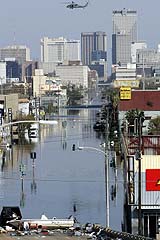
Washington (AFP) Sep 18, 2005 The crisis unleashed in the United States by Hurricane Katrina enters its fourth week on Monday, with the world's most powerful country wrestling with the escalating social, political and fiscal costs of the disaster. The clean-up of Louisiana, Mississippi and Alabama, the three US Gulf coast states singled out for Katrina's wrath on August 29, is now getting into gear and troops that poured into the devastated region to enforce order are gradually being pulled out. In New Orleans, once the jewel of the American southeast, the recovery effort enters a critical phase on Monday. The city hopes that as many as 180,000 people, out of an evacuated population of half a million, will have returned by the end of this week, giving a pulsebeat to what is in effect a ghost town. It will be a phased return, in which inhabitants go back to those districts that were least-hit by Katrina's flood surge, where basic services have been restored and security is provided by a police cordon, troop patrols and a dusk-to-dawn curfew. On Saturday, the first step in the operation got underway when business owners were permitted to return to the historic French Quarter and central districts, located on higher ground and relatively spared the ravages of the flood. But at least a third of the city remains flooded, with the water levels receding by about 30 centimetres (one feet) per day. Some 160,000 New Orleans homes have been so damaged that they will probably have to be bulldozed, according to the Louisiana state government. Returnees cleaning their homes will have to clear away a mountain of debris and be exposed to a thick carpet of sediment laden with bacteria and fuel oil. But the recovery across the Gulf coast will be a long-term task. To survive beyond the first few days of their return, returnees will need jobs, shops, schools and hospitals. The overall death toll from Hurricane Katrina rose beyond 800 at the weekend and may rise steadily in the coming days as more corpses are found in wrecked, abandoned homes. Of the million people who fled the vulnerable regions, around 100,000 are still living in shelters and tens of thousands more are staying with relatives, hotels or other temporary accommodation, some of them scattered around the country. "Katrina is one of the most disruptive and challenging disaster in American history," Tom Mann, senior fellow in governance studies at the Brookings Institution, a Washington thinktank, told AFP. "The scope of the displacement of persons out of the Gulf coast into the rest of the country and the enormity of the economic and social and fiscal challenges leave me very uncertain as to when, if ever, we recover." For George W. Bush, America's worst natural disaster has left an imprint on his presidency that is every bit as deep as the 9/11 terror attacks on the United States and the Iraq War. Across the world, the prestige of the world's only superpower has been enduringly sullied by images of the Third World -- of gun-toting looters, of homes reduced to matchwood, of refugees crying in vain for water and baby milk. At home, the crisis has hit the country hard along the faultlines of inequality and race, for those hit hardest were poor blacks, lacking the means to flee to safety. His approval ratings driven to an all-time low by his governmen's fumbling response to the crisis, Bush has raced to try to recover lost credibility. He has appealed for national unity, sought to project an image of compassion, promised aid and vowed to fix the problems exposed by Katrina. In one of the most important addresses of his tenure, he flew to New Orleans last Thursday where he pledged the city "will rise again" and vowed the federal government would rebuild infrastructure and provide a liferaft of tax incentives for investors and financial aid to help returnees rebuild their lives. "Throughout the area hit by the hurricane, we will do what it takes. We will stay as long as it takes to help citizens rebuild their communities and their lives," Bush promised. Economists are trying to peer through the fog of uncertainty surrounding the ultimate cost of Katrina. Back-of-an-envelope estimates put the tab at up to 200 billion dollars. "It's really in the realm of speculation as to how to price this," said Stephen Slivinski, director of budget studies at the Cato Institute, a conservative thinktank. Before Katrina hit, the Congressional Budget Office estimated the 2006 budget deficit at 314 billion dollars, down from 331 billion for the current fiscal year. "It's clear that the target the White House has set of halving the deficit [as a percentage of gross domestic product] by 2010 is unrealistic," said Slivinski. As Bush has ruled out raising taxes to cover the deficit, the US government's needs are only covered thanks to Asian countries which buy American government bonds. "My concern is the long-term implication," said Slivinski. At what point is the international capital market going to say, 'enough is enough'?" Community Email This Article Comment On This Article Related Links SpaceDaily Search SpaceDaily Subscribe To SpaceDaily Express Bringing Order To A World Of Disasters When the Earth Quakes A world of storm and tempest
 New Orleans Colleges To Reopen This Week
 New Orleans, Louisiana (AFP) Jan 05, 2006
Thousands of students and faculty are returning to New Orleans' eight colleges and universities this week for the first time since hurricane Katrina flooded the city four months ago. |
|
|

| The content herein, unless otherwise known to be public domain, are Copyright 1995-2006 - SpaceDaily.AFP and UPI Wire Stories are copyright Agence France-Presse and United Press International. ESA PortalReports are copyright European Space Agency. All NASA sourced material is public domain. Additionalcopyrights may apply in whole or part to other bona fide parties. Advertising does not imply endorsement,agreement or approval of any opinions, statements or information provided by SpaceDaily on any Web page published or hosted by SpaceDaily. Privacy Statement |