|
 |
 |
 |
 |
 |
 |
 |
 |

 |
Human Exploration Of The Moon And Mars
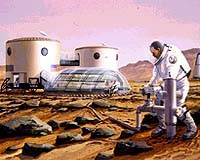
Milton Keynes - Apr 01, 2004 These are exciting times for space exploration. For the first time in a generation, human missions beyond Earth orbit are being seriously considered by space agencies on both sides of the Atlantic. Europe has initiated the Aurora programme, with the ultimate aim of landing people on Mars by 2033, while the US has recently redirected its human space activities towards a return to the Moon. On Friday 2 April, Dr. Ian Crawford, a planetary scientist based at Birkbeck College, London, will be explaining to the RAS National Astronomy Meeting, held at the Open University in Milton Keynes, that there are indeed strong scientific reasons for sending people back to the Moon and on to Mars. These arguments are further developed in an article published in the April issue of the Royal Astronomical Society's journal Astronomy & Geophysics, which is timed to coincide with the meeting. "The reasons for exploring the Moon and Mars are both very strong, but rather different," said Dr. Crawford. "The importance of the Moon results from its extremely ancient surface, which preserves a record of early Solar System history that is not preserved anywhere else. On the other hand, the main reason for wanting to explore Mars is to search for past or present life on the planet, which is probably one of the most important scientific questions of our time." Given that strong scientific cases exist for a human return to the Moon and for sending people on to Mars, Dr. Crawford argues that the two should be combined in a self-consistent, international strategy for Solar System exploration. Europe's Aurora programme could be a major part of such a strategy. The UK will shortly have to decide whether or not to participate in the human spaceflight aspects of Aurora, and Dr. Crawford believes that we should seize this unique opportunity to play a leading role in these exciting endeavours. Given the difficulties of sending people to Mars, Dr. Crawford argues that it would be wiser, initially, to concentrate human spaceflight activities on the Moon. This would not only teach us much about the Moon and its history, but also help pave the way for later human missions to Mars by developing the necessary technology and expertise. However, the robotic exploration of Mars could, and should, continue in parallel with a manned lunar programme. "By pursuing parallel programmes to build up a human spaceflight capability on the Moon and to advance robotic Mars exploration, there is a realistic chance that we will have developed both the human spaceflight expertise and the detailed knowledge of the Martian environment to make human missions to the Red Planet both scientifically worthwhile and technically feasible before the middle of this century," said Dr. Crawford. Community Email This Article Comment On This Article Related Links ESA's Aurora Programme Dr. Crawford's article in Astronomy & Geophysics Ian Crawford Page SpaceDaily Search SpaceDaily Subscribe To SpaceDaily Express Mars News and Information at MarsDaily.com Lunar Dreams and more
 Spirit Heading To 'Home Plate'
 Pasadena CA (JPL) Jan 09, 2006
Last week Spirit completed robotic-arm work on "El Dorado." The rover used all three of its spectrometers plus the microscopic imager for readings over the New Year's weekend. |
|
|

| The content herein, unless otherwise known to be public domain, are Copyright 1995-2006 - SpaceDaily.AFP and UPI Wire Stories are copyright Agence France-Presse and United Press International. ESA PortalReports are copyright European Space Agency. All NASA sourced material is public domain. Additionalcopyrights may apply in whole or part to other bona fide parties. Advertising does not imply endorsement,agreement or approval of any opinions, statements or information provided by SpaceDaily on any Web page published or hosted by SpaceDaily. Privacy Statement |