|
 |
 |
 |
 |
 |
 |
 |
 |

 |
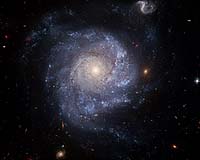
Hubble Snaps Images Of A Pinwheel-Shaped Galaxy
Baltimore Md. (SPX) Feb 7, 2006 Looking like a child's pinwheel ready to be set a spinning by a gentle breeze, the Hubble Space Telescope has captured fine details of spiral galaxy NGC 1309, seen face-on. Astronomers at the Space Telescope Science Institute took recent Hubble observations of the galaxy in visible and infrared light and combined them, revealing NGC 1309's features: bright blue areas of star formation peppering the spiral arms, with ruddy dust lanes following the spiral structure into a yellowish central nucleus of older-population stars. Many far-off background galaxies complement the image. STScI team members said the galaxy image is more than just a pretty picture � it also is helping to measure the expansion rate of the universe more accurately. NGC 1309 was home to supernova SN 2002fk, whose light reached Earth in September 2002. The event, known as a Type 1a supernova, resulted from a white dwarf star accreting matter from a companion in a binary system. When the white dwarf collected enough mass and was no longer able to sustain its internal nuclear fusion reactions, the star detonated, becoming the brightest object in the galaxy for several weeks. Nearby Type 1a supernovae like SN 2002fk in NGC 1309 are used by astronomers to calibrate distance measures in the universe. By comparing nearby Type 1a supernovae to more distant ones, they can determine not only whether the universe is expanding, but whether the expansion is accelerating. This method works, however, only if the distance to the host galaxies is known extremely well. That's where the Hubble comes into play. Because NGC 1309 is relatively close to Earth, the high resolution of the space telescope's Advanced Camera for Surveys can help accurately determine the distance to the galaxy by looking at the light output of a particular type of star called a Cepheid variable. Cepheids are well studied within the Milky Way, and they vary regularly in brightness at a rate that related to their total intrinsic brightness. By comparing their variation rate with how bright they appear, astronomers can deduce their distance. In this way, the Cepheids in NGC 1309 will allow astronomers to measure the distance to NGC 1309 - and thus to SN 2002fk - with great accuracy. The expansion of the universe was discovered by Edwin Hubble, the telescope's namesake, nearly a century ago, but the accelerating universe is a recent discovery that has produced interesting questions for cosmological theorists. Community Email This Article Comment On This Article Related Links Hubble Site Space Telescope News and Technology at Skynightly.com
 Telescope Fits Into Rocket Body To Improve Imagery
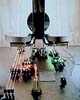 Kirtland Air Force Base NM (SPX) Jan 25, 2006
Positioning three delicate, circular mirrors to one one-thousandth of the width of a human hair consistently challenged scientists at the Space Vehicles Directorate, Kirtland Air Force Base, N.M. |
|
|

| The content herein, unless otherwise known to be public domain, are Copyright 1995-2006 - SpaceDaily.AFP and UPI Wire Stories are copyright Agence France-Presse and United Press International. ESA PortalReports are copyright European Space Agency. All NASA sourced material is public domain. Additionalcopyrights may apply in whole or part to other bona fide parties. Advertising does not imply endorsement,agreement or approval of any opinions, statements or information provided by SpaceDaily on any Web page published or hosted by SpaceDaily. Privacy Statement |