
 |
 |
 |
 |
 |
 |
 |
 |
 |

 |
Hubble Sees Magnetic Monster In Erupting Galaxy
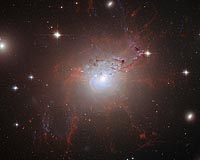
Cambridge, UK (SPX) Aug 21, 2008 The Hubble Space Telescope has found the answer to a long- standing puzzle by resolving giant but delicate filaments shaped by a strong magnetic field around the active galaxy NGC 1275. It is the most striking example of the influence of these immense tentacles of extragalactic magnetic fields, say researchers. NGC 1275 is one of the closest giant elliptical galaxies and lies at the centre of the Perseus Cluster of galaxies. It is an active galaxy, hosting a supermassive black hole at its core, which blows bubbles of radio-wave emitting material into the surrounding cluster gas. Its most spectacular feature is the lacy filigree of gaseous filaments reaching out beyond the galaxy into the multi-million degree X-ray emitting gas that fills the cluster. These filaments are the only visible-light manifestation of the intricate relationship between the central black hole and the surrounding cluster gas. They provide important clues about how giant black holes affect their surrounding environment. A team of astronomers using the NASA/ESA Hubble Space Telescope Advanced Camera for Surveys have for the first time resolved individual threads of gas which make up the filaments. The amount of gas contained in a typical thread is around one million times the mass of our own Sun. They are only 200 light-years wide, are often surprisingly straight, and extend for up to 20 000 light-years. The filaments are formed when cold gas from the galaxy's core is dragged out in the wake of rising bubbles blown by the black hole. It has been a challenge for astronomers to understand how the delicate structures withstood the hostile high-energy environment of the galaxy cluster for more than 100 million years. They should have heated up, dispersed, and evaporated over a very short period of time, or collapsed under their own gravity to form stars. Even more puzzling is the fact that they haven't been ripped apart by the strong tidal pull of gravity in the cluster's core. A new study led by Andy Fabian from the University of Cambridge, UK, published in Nature on 21 August 2008 proposes that the magnetic fields hold the charged gas in place and resist forces that would distort the filaments. This skeletal structure has been able to contain and suspend these peculiarly long threads for over 100 million years. "We can see that the magnetic fields are crucial for these complex filaments - both for their survival and for their integrity", said Fabian. The new Hubble data also allowed the strength of the magnetic fields in the filaments to be determined from their size. Thinner filaments are more fragile, requiring stronger magnetic fields for support. However, the finer the filaments, the more difficult they are to observe. The filamentary system in NGC 1275 provides the most striking example of the workings of extragalactic magnetic fields so far and is a spectacular by-product of the complex interaction between the cluster gas and the supermassive black hole at the galaxy's heart. Similar networks of filaments are found around many other, even more remote, central cluster galaxies. They cannot be observed in anything like the detail of NGC 1275, so the team will apply the understanding gained here to interpret observations of these more distant galaxies. Community Email This Article Comment On This Article Share This Article With Planet Earth
Related Links Institute of Astronomy, University of Cambridge Stellar Chemistry, The Universe And All Within It
 Globular Clusters Tell Tale Of Star Formation In Nearby Galaxy Metropolis
 Baltimore MD (SPX) Aug 06, 2008
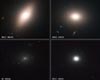
Globular star clusters, dense bunches of hundreds of thousands of stars, have some of the oldest surviving stars in the universe. A new study of globular clusters outside our Milky Way Galaxy has found evidence that these hardy pioneers are more likely to form in dense areas, where star birth occurs at a rapid rate, instead of uniformly from galaxy to galaxy. |
|
|

| The content herein, unless otherwise known to be public domain, are Copyright 1995-2007 - SpaceDaily.AFP and UPI Wire Stories are copyright Agence France-Presse and United Press International. ESA Portal Reports are copyright European Space Agency. All NASA sourced material is public domain. Additional copyrights may apply in whole or part to other bona fide parties. Advertising does not imply endorsement,agreement or approval of any opinions, statements or information provided by SpaceDaily on any Web page published or hosted by SpaceDaily. Privacy Statement |
 del.icio.us
 Digg
Digg Reddit
 YahooMyWeb
 Google
 Facebook
