|
 |
 |
 |
 |
 |
 |
 |
 |

 |
Hubble Main Camera Experiences Power Problem
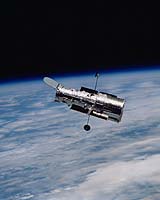
SpaceDaily US Editor Washington DC (SPX) Jun 26, 2006 The Advanced Camera for Surveys, the main instrument aboard the Hubble Space Telescope, shut itself down last week and despite repeated attempts by ground controllers to revive it, continues to hibernate in a safe mode, SpaceDaily.com has learned. "It sounds like a power-supply problem, which is now being diagnosed," Ray Villard, a spokesman for the Space Telescope Science Institute in Baltimore, Md., which manages the spacecraft's science activities, told SpaceDaily.com. "We have a redundant power bus as backup." The backup system is meant to power the camera if its main power supply fails. If engineers at NASA's Goddard Space Flight Center in Greenbelt, Md. - which manages the spacecraft - determine they must resort to auxiliary power, then the ACS will have no alternative remaining if it malfunctions again. The ACS is Hubble's most valuable instrument, not only because of its exquisite sensitivity, but also because the camera can detect images in a wide range of electromagnetic wavelengths, from far ultraviolet to infrared. Installed aboard the orbiting telescope during a space shuttle servicing mission in 2002, the camera actually is a combination of three instruments, including a wide-field camera, high-resolution camera, and solar-blind camera. The wide-field camera on the ACS can capture a panorama twice as wide as Hubble's Wide Field Planetary Camera 2. The high-resolution camera can take extremely detailed pictures of distant objects, such as the two newly discovered tiny moons of Pluto, which have just been named Nix and Hydra. The solar-blind camera blocks visible light to enhance the telescope's sensitivity to UV light. The instrument specializes in detecting hot stars radiating in UV wavelengths. Ever since the space shuttle Columbia disintegrated over Texas on Feb. 1, 2003, during its re-entry into the atmosphere, and NASA grounded the fleet, Hubble scientists and engineers have lacked the means to service the telescope, which remains - and will continue to remain for the foreseeable future - the best visible-light telescope available. That situation may change in the next couple of years if the shuttle's safety and reliability can be re-established. NASA Administrator Michael Griffin has said on repeated occasions that he favors sending one more shuttle mission to service Hubble - if that mission's safety can be reasonable assured. The National Academy of Sciences has supported Griffin's position. In a report last year, an NAS panel recommended using the shuttle to service Hubble instead of a robotic spacecraft, because that technology is not yet sufficiently mature. Along with the ACS power supply, Hubble faces deteriorating gyroscopes - which are essential to maintaining its steadiness and correct position while collecting images - as well as aging batteries. These factors also could bring to a sudden end the spacecraft's extraordinary performance over the past decade and a half. Meanwhile, Hubble controllers are planning to attempt to restart the ACS using the auxiliary power system sometime this week. Community Email This Article Comment On This Article Related Links Hubble Space Telescope News and Technology at Skynightly.com
 Webb Telescope Mirror Backplane Prototype Delivered For Testing
 Redondo Beach CA (SPX) Jun 21, 2006
Northrop Grumman announced Wednesday it has delivered an important element of the James Webb Space Telescope, the Backplane Stability Test Article, to NASA's Marshall Space Flight Center for a series of tests designed to verify its readiness for use in space. |
|
|

| The content herein, unless otherwise known to be public domain, are Copyright 1995-2006 - SpaceDaily.AFP and UPI Wire Stories are copyright Agence France-Presse and United Press International. ESA PortalReports are copyright European Space Agency. All NASA sourced material is public domain. Additionalcopyrights may apply in whole or part to other bona fide parties. Advertising does not imply endorsement,agreement or approval of any opinions, statements or information provided by SpaceDaily on any Web page published or hosted by SpaceDaily. Privacy Statement |