|
 |
 |
 |
 |
 |
 |
 |
 |

 |
Hubble Discovers A Dark Cloud In The Atmosphere Of Uranus
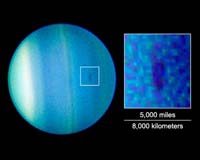
Madison WI (SPX) Oct 02, 2006 Just as we near the end of the hurricane season in the Atlantic Ocean, winds whirl and clouds churn 2 billion miles away in the atmosphere of Uranus, forming a dark vortex large enough to engulf two-thirds of the United States. Lawrence Sromovsky of the University of Wisconsin-Madison leads a team that used NASA's Hubble Space Telescope to take the first definitive images of a dark spot on Uranus. The elongated feature measures 1,100 miles by 1,900 miles (1,700 kilometers by 3,000 kilometers). There have been prior unconfirmed sightings of dark spots on Uranus, including sketches made in the early 1900s, low-contrast ultraviolet Voyager spacecraft flyby images in 1986, and near-infrared observations taken from a ground-based observatory in 1993. However, no other Hubble images taken almost every summer from 1994 through early 2006 have shown such a dark spot. This indicates that the current dark disturbance probably formed very recently, researchers said. Although rare on Uranus, dark spots have been frequently observed on Neptune. Uranus is similar in size and atmospheric composition to Neptune, but it has not appeared to have as active an atmosphere. Recently, however, Uranus's atmosphere has shown an increase in activity. The development of a dark spot may be a signal of the oncoming uranian northern spring, said researchers. Uranus is approaching its December 2007 equinox, when the Sun will shine directly over the equator. "We have hypothesized that Uranus might become more Neptune-like as it approached its equinox," said team member Heidi B. Hammel of the Space Science Institute in Boulder, Colo. "The sudden appearance of this unusual dark feature suggests we might be right." The dark spot was detected at a latitude of 27 degrees in Uranus's northern hemisphere, which is just now becoming fully exposed to sunlight after many years of being in shadow. Astronomers are keenly interested in how strongly and quickly the atmosphere of Uranus seems to be responding to seasonal sunlight changes. Uranus's rotation axis is tilted almost parallel to its orbital plane, such that the planet appears to be rotating on its side. This sideways orientation leads to extreme seasons during the planet's 84-year path around the Sun. Community Email This Article Comment On This Article Related Links Space Science and Engineering Center at Wisconsin-Madison Hubble Site Lost Among A Million Outer Planets The Gas Giants of Sol - Jupiter, Saturn, Uranus, Neptune
 Venus Guides Stargazers To Uranus In April
 Washington DC (SPX) Apr 13, 2006
Ancient people didn't have TV or electric lights. So, when the Sun went down every night, they got their entertainment by watching the sky. And it was entertaining. Without city lights to interfere, the Milky Way was spectacular. Meteors flitted across the sky. Zodiacal lights chased the sunset. |
|
|

| The content herein, unless otherwise known to be public domain, are Copyright 1995-2006 - SpaceDaily.AFP and UPI Wire Stories are copyright Agence France-Presse and United Press International. ESA PortalReports are copyright European Space Agency. All NASA sourced material is public domain. Additionalcopyrights may apply in whole or part to other bona fide parties. Advertising does not imply endorsement,agreement or approval of any opinions, statements or information provided by SpaceDaily on any Web page published or hosted by SpaceDaily. Privacy Statement |