|
 |
 |
 |
 |
 |
 |
 |
 |

 |
Hubble Captures Its Biggest Galaxy Image Yet
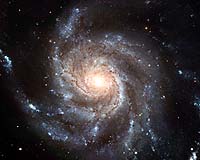
Baltimore MD (SPX) Feb 28, 2006 The Hubble Space Telescope's new image of the face-on spiral galaxy Messier 101 is the largest and most detailed photo of a spiral galaxy yet compiled by the orbiting observatory - and one of the largest composite galaxy images ever. M101 - also known as the Pinwheel - is a gigantic galaxy and one of the best-known examples of grand-design spirals. The image features millions of individual stars and supergiant star-forming regions in unprecedented detail. The portrait actually is composed of 51 individual Hubble exposures, in addition to elements from images from ground-based photos. The final composite image measures 16,000 by 12,000 pixels. Astronomers assembled the image from archived observations that were originally acquired for a range of Hubble projects, such as determining the expansion rate of the universe, studying the formation of star clusters in the giant star birth regions, finding the stars responsible for intense X-ray emissions, and discovering blue supergiant stars. A group at Johns Hopkins University and NASA recently cataloged nearly 3,000 previously undetected star clusters in M101. The giant spiral disk of stars, dust, and gas is 170,000 light-years across or nearly twice the diameter of the Milky Way. More distinctive, M101 could contain at least 1-trillion stars, approximately 100-billion of which could be like the Sun, in terms of temperature and lifetime. The galaxy's spiral arms are sprinkled with large regions of star-forming nebulae - areas of intense star formation within giant molecular hydrogen clouds. Brilliant young clusters of hot, blue, newborn stars trace out the spiral arms. The disk of M101 is so thin that Hubble can easily see many more distant galaxies lying behind the galaxy. The Pinwheel lies within the northern constellation Ursa Major - The Great Bear - about 25 million light-years from Earth. The galaxy fills a region in the sky equal to one-fifth the area of the full Moon. The M101 photo's archival elements include images taken with Hubble's Advanced Camera for Surveys and its Wide Field and Planetary Camera in March and September 1994, and in June 1999, November 2002, and January 2003. Astronomers superimposed the Hubble exposures onto ground-based images, visible at the edge of the image, taken at the Canada-France-Hawaii Telescope in Hawaii, and at the 0.9-meter telescope at Kitt Peak National Observatory, part of the National Optical Astronomy Observatory in Arizona. The final color image was assembled from individual exposures taken through blue, green, and red (infrared) filters. Community Email This Article Comment On This Article Related Links Hubble at ESA Hubble at NASA Space Telescope News and Technology at Skynightly.com
 JAXA Akari Space Telescope In Orbit
 Uchinoura Space Center Japan (SPX) Feb 22, 2006
JAXA has confirmed through telemetry that the Akari infrared space telescope has deployed its solar array paddle successfully. The spacecraft, which was launched at 6:28 a.m. local time Wednesday aboard an M-V-8 rocket, originally was named ASTRO-F, but mission controllers renamed it Akari, meaning a "light," as soon as it entered orbit. |
|
|

| The content herein, unless otherwise known to be public domain, are Copyright 1995-2006 - SpaceDaily.AFP and UPI Wire Stories are copyright Agence France-Presse and United Press International. ESA PortalReports are copyright European Space Agency. All NASA sourced material is public domain. Additionalcopyrights may apply in whole or part to other bona fide parties. Advertising does not imply endorsement,agreement or approval of any opinions, statements or information provided by SpaceDaily on any Web page published or hosted by SpaceDaily. Privacy Statement |