|
 |
 |
 |
 |
 |
 |
 |
 |

 |
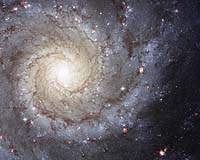
Hubble Captures Grand-Design Spiral Galaxy M74
Baltimore MD (SPX) Nov 30, 2007 Messier 74, also called NGC 628, is a stunning example of a grand-design spiral galaxy that is viewed by Earth observers nearly face-on. Its perfectly symmetrical spiral arms emanate from the central nucleus and are dotted with clusters of young blue stars. In the new Hubble image a smattering of bright pink regions decorating the spiral arms can also be seen. These are huge, relatively short-lived, clouds of hydrogen gas which glow due to the strong radiation from hot, young stars embedded within them; glowing pink regions of ionized hydrogen (hydrogen that has lost its electrons). These regions of star formation show an excess of light at ultraviolet wavelengths and astronomers call them HII regions. Tracing along the spiral arms are winding dust lanes that begin very near the galaxy's nucleus and follow along the length of the spiral arms. These spiral arms are not actually static arms like spokes on a wheel. They are in fact density waves and move around the galaxy's disc compressing gas - just as sound waves compress the air on Earth - creating a new generation of young blue stars. Messier 74 is located roughly 32 million light-years away in the direction of the constellation Pisces, the Fish. It is the dominant member of a small group of about half a dozen galaxies, the Messier 74 galaxy group. In its entirety, it is estimated that Messier 74 is home to about 100 thousand million stars, making it slightly smaller than our Milky Way. The spiral galaxy was first discovered by the French astronomer, Pierre Mechain, in 1780. Weeks later it was added to Charles Messier's famous catalogue of deep-sky objects. Of all the objects in Messier's catalogue, number 74 has the lowest surface brightness. It is so difficult for amateur astronomers to spot through a telescope that it has been given the nickname the Phantom Galaxy. This Hubble image of Messier 74 is a composite of Advanced Camera for Surveys' data taken in 2003 and 2005. The filters used to create the colour image isolate light from blue, visible, and infrared portions of the spectrum, as well as emission from ionized hydrogen. A small segment of this image used data from the Canada France Hawaii Telescope/Gemini Observatory telescope to fill in a region which Hubble did not image. Community Email This Article Comment On This Article Related Links Space Telescope News and Technology at Skynightly.com
 Shock At Decision To Pull UK Out Of Gemini Observatory
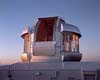 London, UK (SPX) Nov 27, 2007
The Council of the Royal Astronomical Society (RAS), the UK's society for professional astronomers and geophysicists, have expressed their shock at the sudden decision of the Science and Technology Facilities Council (STFC) to withdraw the UK from the Gemini Observatory. |
|
|

| The content herein, unless otherwise known to be public domain, are Copyright 1995-2007 - SpaceDaily.AFP and UPI Wire Stories are copyright Agence France-Presse and United Press International. ESA Portal Reports are copyright European Space Agency. All NASA sourced material is public domain. Additional copyrights may apply in whole or part to other bona fide parties. Advertising does not imply endorsement,agreement or approval of any opinions, statements or information provided by SpaceDaily on any Web page published or hosted by SpaceDaily. Privacy Statement |