|
 |
 |
 |
 |
 |
 |
 |
 |

 |
Hubble And Sloan Quadruple Number Of Known Optical Einstein Rings
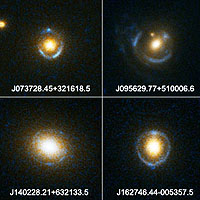
Cambridge MA (SPX) Nov 18, 2005 Astronomers have combined two powerful astronomical assets, the Sloan Digital Sky Survey (SDSS) and NASA's Hubble Space Telescope, to identify 19 new "gravitationally lensed" galaxies. Among these 19, they have found eight new so-called "Einstein rings", which are perhaps the most elegant manifestation of the lensing phenomenon. Only three such rings had previously been seen in visible light. In gravitational lensing, light from distant galaxies is deflected on its way to Earth by the gravitational field of any massive object that lies in the way. Because of this light bending, the galaxy is distorted into an arc or multiple separate images. When both galaxies are exactly lined up, the light forms a bull's-eye pattern, called an Einstein ring, around the foreground galaxy. Besides producing odd shapes, gravitational lensing gives astronomers the most direct probe of the distribution of dark matter in elliptical galaxies. Dark matter is an invisible and exotic form of matter that has not yet been directly observed. By searching for dark matter in galaxies, astronomers hope to gain insight into galaxy formation, which must have started around lumpy concentrations of dark matter in the early universe. The newly discovered lenses come from an ongoing project called the Sloan Lens Survey (SLACS). A team of astronomers, led by Adam Bolton of the Harvard-Smithsonian Center for Astrophysics in Cambridge, Mass., and Leon Koopmans of the Kapteyn Astronomical Institute in the Netherlands, selected the candidate lenses from among several hundred thousand optical spectra of elliptical galaxies in the Sloan Digital Sky Survey. The team was looking for clear evidence of emission from galaxies twice as far from Earth and directly behind the closer galaxies. They used Hubble's Advanced Camera for Surveys to snap images of 28 of these candidate lensing galaxies. By studying the arcs and rings produced by 19 of these candidates, the astronomers precisely measured the mass of the foreground galaxies. These new discoveries add significantly to the approximately 100 gravitational lenses previously known. "Being able to study these and other gravitational lenses as far back in time as several billion years allows us to see directly whether the distribution of invisible and visible mass changes with cosmic time," says Koopmans. "With this information, we can test the commonly held idea that galaxies form from collision and mergers of smaller galaxies." The initial findings of the survey will appear in the February 2006 issue of the Astrophysical Journal. Community Email This Article Comment On This Article Related Links Sloan Digital Sky Survey NASA's Hubble Space Telescope SpaceDaily Search SpaceDaily Subscribe To SpaceDaily Express Stellar Chemistry, The Universe And All Within It
 Sloan Survey Identifies New Dwarf Galaxy Inside Milky Way
 Washington DC (SPX) Jan 10, 2006
Astronomers using the Sloan Digital Sky Survey have discovered a previously unknown cluster of stars within the Milky Way that appears to be a separate dwarf galaxy being consumed by its much larger neighbor.
--------------------------------------------------------- It's new. And it's downright terrific! Celestron's CPC Schmidt-Cassegrain telescope is the scope you've been waiting for! It offers new alignment technology, advanced engineering, and bold new design at a new, low price! In fact, Celestron's Professional Computerized (CPC) scope with revolutionary SkyAlign Alignment Technology redefines everything that amateur astronomers are looking for. It offers quick and simple alignment, GPS technology, unsurpassed optical quality, ease of use, advanced ergonomics, enhanced computerization and, most important, affordability. Want to view M-31 tonight? One button takes you there!
Shop for telescopes online at Telescopes.com! today!
|
|
|

| The content herein, unless otherwise known to be public domain, are Copyright 1995-2006 - SpaceDaily.AFP and UPI Wire Stories are copyright Agence France-Presse and United Press International. ESA PortalReports are copyright European Space Agency. All NASA sourced material is public domain. Additionalcopyrights may apply in whole or part to other bona fide parties. Advertising does not imply endorsement,agreement or approval of any opinions, statements or information provided by SpaceDaily on any Web page published or hosted by SpaceDaily. Privacy Statement |