|
 |
 |
 |
 |
 |
 |
 |
 |

 |
Hu Pushes Embargo Lifting On U.K. Trip
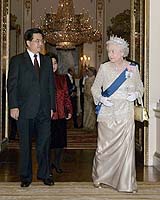
London (UPI) Nov 08, 2005 Chinese President Hu Jintao arrived in Britain Tuesday amid all the pomp and grandiosity of a state visit, and was greeted at Buckingham Palace by leading royals, politicians and flag-waving supporters. But underneath the ceremony his visit is likely to be marred by a variety of uncomfortable issues on which agreement is a distant prospect. Top of the Chinese agenda is the lifting of the European Union arms embargo on China that Beijing hopes it can get lifted with British support. Hu is hoping to kick-start the stalled EU negotiations over the embargo, imposed in the wake of the Tiananmen Square massacre of 1989. European countries came close to rescinding the ban earlier this year; however the process was halted after the Chinese government passed a law authorizing military action against Taiwan if it made a bid for independence, a move that enraged both the United States and Japan. Chinese Foreign Minister Li Zhaoxing said last week he and Hu would urge London to back the lifting of the ban, which he said was discriminatory and hampered trade between his country and Europe. China had no plans to buy weapons from Europe but opposed the ban on principle, he said, according to China's official Xinhua news service. Yiyi Lu of London-based international affairs think-tank Chatham House said Beijing perceived the legislation on Taiwan as "an excuse" for halting the process, which was really because of the "vehement opposition" from the United States and Japan. Europe had not expected the issue to be taken so seriously by Washington, she said, and had eventually bowed to pressure, she told United Press International. London is keen to avoid the issue, which it says should be discussed in Europe and not in bilateral talks with individual member states. Britain had initially come out strongly in favor of lifting the ban, arguing China had moved on considerably since the appalling events of Tiananmen almost two decades ago. "China's got a legitimate right to ask for normal trade relations," Denis MacShane, then British minister for Europe, told UPI earlier this year. Spain and Germany, who will host Hu next, had been vocal supporters of lifting the ban. However Germany's new chancellor-designate, Angela Merkel, has signaled she will take a more trans-Atlantic view. Friedbert Pfluger, a foreign policy expert at Merkel's CDU party, said according to FT Deutschland Tuesday that the lifting of the embargo was "not on the agenda." And under intense U.S. pressure, Britain has retreated to a position of virtual silence on the issue. Asked at his monthly news conference Monday what would be discussed during Hu's visit, Prime Minister Tony Blair made no mention of the embargo. Key topics would be the deepening economic relations between the two countries, matters of global security and climate change, he said. He would also appreciate the opportunity to hear from the president on China's economic and political progress, Blair said. A Foreign Office official told UPI Tuesday Britain did not consider the arms embargo to be an "appropriate" subject for discussion at the bilateral talks. It was an issue that Britain was continuing to discuss with its EU partners, and should remain exclusively in that forum, she said. Blair will therefore have a difficult balance to strike in his talks with the Chinese leader. There will be some thorny issues to navigate, not only the arms embargo but also concerns over Chinese human rights abuses, underlined by vociferous protests taking place in the British capital throughout the president's three-day visit. A Chinese minister among the delegation, Bo Xilai, will also face a legal action brought by a British campaign group for his alleged involvement in crimes against humanity, including torture. However, Britain is keenly aware of the growing importance of the Chinese economy and wants to ensure it is to British and European advantage. Politically, China is becoming an increasingly prominent global player and its cooperation is vital on many international issues. Action on climate change is unlikely to be effective without the participation of the world's most populous nation. China is also a lynchpin of efforts to rein in North Korea's nuclear development. And as a permanent member of the U.N. Security Council, China's position on U.N. reform and Iran's burgeoning nuclear ambitions is of crucial importance. Europe and the United States want the Security Council to take decisive action against Iran over its nuclear program, which was declared to be in non-compliance with the nuclear non-proliferation treaty in September. However, sanctions are not compatible with China's high demand for energy and the web of energy deals it has already struck with Iran. Lu said Beijing maintained its position that the international community should not "rush in" to sanctions against Iran. It wanted the European Union to continue pursuing a diplomatic solution through negotiations, she told UPI. Economic relations are likely to be the area on which Hu and Blair find the most common ground. On this issue, the rhetoric is that of cordial partnership. The president said Tuesday in a written statement upon his arrival he hoped the visit would push forward the China-U.K. comprehensive strategic relationship, developed last year to strengthen cooperation on areas such as trade and investment, technology and education. "In recent years, the China-U.K. relationship has maintained a sound momentum of growth, and cooperation in various fields has produced fruitful results," he said. "Further developing the China-UK comprehensive strategic partnership is in the fundamental interests of the two countries and the two peoples." Even here there are points of contention. Britain and France remain at odds over whether to offer a reduction in agricultural subsidies at the World Trade Organization talks in December, an obstacle which will stifle trade discussions with China. Likewise, a September deal to resolve the so-called "bra wars" between the European Union and China was little more than a temporary compromise, and further trade clashes are inevitable. But these are discussions that Blair would rather avoid in his final two months as head of Britain's EU presidency. Blair will host Hu at Downing Street Wednesday for bilateral discussions; the president will also address Parliament's lower chamber, the House of Commons. It is on these events that domestic and international attention will be focused. Community Email This Article Comment On This Article Related Links SpaceDaily Search SpaceDaily Subscribe To SpaceDaily Express China News from SinoDaily.com
 China Wants To Expand Sino-US Military Relations
 Beijing (AFP) Jan 10, 2006
China is ready to expand its military relations with the United States, Chinese Defense Minister Cao Gangchuan said on Tuesday. |
|
|

| The content herein, unless otherwise known to be public domain, are Copyright 1995-2006 - SpaceDaily.AFP and UPI Wire Stories are copyright Agence France-Presse and United Press International. ESA PortalReports are copyright European Space Agency. All NASA sourced material is public domain. Additionalcopyrights may apply in whole or part to other bona fide parties. Advertising does not imply endorsement,agreement or approval of any opinions, statements or information provided by SpaceDaily on any Web page published or hosted by SpaceDaily. Privacy Statement |