
 |
 |
 |
 |
 |
 |
 |
 |
 |

 |
How Will The Arctic Sea Ice Cover Develop This Summer
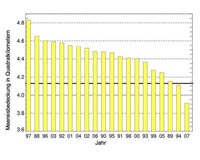
Bonn, Germany (SPX) Jul 11, 2008 The ice cover in the Arctic Ocean at the end of summer 2008 will lie, with almost 100 per cent probability, below that of the year 2005 - the year with the second lowest sea ice extent ever measured. Chances of an equally low value as in the extreme conditions of the year 2007 lie around eight per cent. Climate scientists from the Alfred Wegener Institute for Polar and Marine Research in the Helmholtz Association come to this conclusion in a recent model calculation. They participate with their prognosis in an international scientific contest, in which some of the most renowned institutes on climate research want to fathom out possibilities for seasonal predictions on Arctic sea ice cover by means of different methods and climate models. "After the strong decrease of the Arctic ice during the last summer, climate scientists all around the world are constantly asked: how will the ice develop in the next years?" describes Prof. Dr. Rudiger Gerdes from the Alfred Wegener Institute his motivation. "To answer this question, we did not want to guess, but to rely on sound calculations." The scientists' problem: scenarios of the long-term development of sea ice clearly indicate a de-creased ice cover - exact prognoses for the following summer, however, are not yet possible. This is mainly due to the fact that the short-term development of sea ice depends strongly on the actual atmospheric conditions, namely the weather and in particular wind, cloud cover and air temperatures. Because the exact atmospheric conditions which determine the weather patterns in the Arctic Ocean during the coming months are not predictable, Rudiger Gerdes and his team have entered atmospheric data of the last twenty years into an ocean sea ice model developed at the Alfred Wegener Institute. "Through this, we are still not able", says Gerdes, "to make a definitive statement on sea ice cover in September. However, this 'trick' enables us to compute the bandwidth of possible ice covers, and to quantify the probability of extreme events." Apart from the variability of atmospheric quantities during the melting season, ice thickness at the beginning of the season determines the new ice minimum. Accordingly, computations of ice thickness enter the models of the researchers from Bremerhaven. Start conditions from June 27th 2008 were used for their current prognosis. Different from long-term prognoses, the researchers' forecasts can quickly be checked by reality. This is all right by Rudiger Gerdes and his team. "It is a first test, and all participating researchers are eager to know how their prognosis has fared at the end of the summer. In the end, this small competition serves the optimisation of our models, so that we are able to improve our predictions concerning short-term seasonal fluctuations. It has to be added, however, that even perfect models would not be able to rule out a component of chance regarding the atmosphere. These forecasts will always be about probability, and not exact prognoses." Community Email This Article Comment On This Article Share This Article With Planet Earth
Related Links Helmholtz Association of German Research Centres Beyond the Ice Age
 North Pole may have no ice this summer: US expert
 Washington (AFP) June 27, 2008
There could briefly be no ice at the North Pole this summer, a US scientist said Friday, an event that would mark a new stage in the melting of the Arctic ice sheets due to global warming. |
|
|

| The content herein, unless otherwise known to be public domain, are Copyright 1995-2007 - SpaceDaily.AFP and UPI Wire Stories are copyright Agence France-Presse and United Press International. ESA Portal Reports are copyright European Space Agency. All NASA sourced material is public domain. Additional copyrights may apply in whole or part to other bona fide parties. Advertising does not imply endorsement,agreement or approval of any opinions, statements or information provided by SpaceDaily on any Web page published or hosted by SpaceDaily. Privacy Statement |
 del.icio.us
 Digg
Digg Reddit
 YahooMyWeb
 Google
 Facebook