
 |
 |
 |
 |
 |
 |
 |
 |
 |

 |
How Stars Form Very Close To Black Holes
St Andrews, UK (SPX) Aug 22, 2008 The mystery of how young stars can form within the deep gravity of black holes has been solved by a team of astrophysicists at the Universities of St Andrews and Edinburgh. The team, partly funded by the Science and Technology Facilities Council (STFC), made the discovery after developing computer simulations of giant clouds of gas being sucked into black holes. The new research may help scientists gain better understanding of the origin of stars and supermassive black holes in our Galaxy and the Universe. The new discovery is published in the journal Science. Until now, scientists have puzzled over how stars could form around a black hole, since molecular clouds - the normal birth places of stars - would be ripped apart by the black hole's immense gravitational pull. However, the new study by Professor Ian Bonnell (St Andrews) and Dr Ken Rice (Edinburgh) found that stars appear to form from an elliptical-shaped disc, the remnant of a giant gas cloud torn apart as it encounters a black hole. The discovery of hundreds of young stars, of high masses and making oval-shaped orbits around a black hole three million times more massive than the sun, and at the centre of our Galaxy, is described as one of the most exciting recent discoveries in astrophysics. Prof Bonnell comments "These simulations show that young stars can form in the neighbourhood of supermassive black holes as long as there is a reasonable supply of massive clouds of gas from further out in the Galaxy." The simulations, performed on the Scottish Universities Physics Alliance (SUPA) SGI Altix supercomputer - taking over a year of computer time - followed the evolution of two separate giant gas clouds up to 100,000 times the mass of the sun, as they fell towards the supermassive black hole. The simulations show how the clouds are pulled apart by the immense gravitational pull of the black hole. The disrupted clouds form into spiral patterns as they orbit the black hole; the spiral patterns remove motion energy from gas that passes close to the black hole and transfers it to gas that passes further out. This allows part of the cloud to be captured by the black hole while the rest escapes. In these conditions, only high mass stars are able to form and these stars inherit the eccentric orbits from the disc. These results match the two primary properties of the young stars in the centre of our Galaxy: their high mass and their eccentric orbits around the supermassive black hole. Dr Rice comments "The crucial element was the modelling of the heating and cooling of the gas as this tells us how much mass is needed for part of the gas to have enough gravity to overcome its own gas pressure, and thus form a star. The heating is caused by the extreme compression of the cloud as it is squashed and pulled apart by the black hole. This is balanced by the cooling which requires detailed knowledge of how quickly the radiation can escape the cloud." Professor Bonnell concluded, "That the stars currently present around the Galaxy's supermassive black hole have relatively short lifetimes of approximately 10 million years, suggests that this process is likely to be repetitive. Such a steady supply of stars into the vicinity of the black hole, and a diet of gas directly accreted by the black hole, may help us understand the origin of supermassive black holes in our and other galaxies in the Universe." Community Email This Article Comment On This Article Share This Article With Planet Earth
Related Links University of St Andrews Stellar Chemistry, The Universe And All Within It
 Hubble Sees Magnetic Monster In Erupting Galaxy
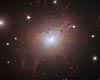 Cambridge, UK (SPX) Aug 21, 2008
The Hubble Space Telescope has found the answer to a long- standing puzzle by resolving giant but delicate filaments shaped by a strong magnetic field around the active galaxy NGC 1275. It is the most striking example of the influence of these immense tentacles of extragalactic magnetic fields, say researchers. |
|
|

| The content herein, unless otherwise known to be public domain, are Copyright 1995-2007 - SpaceDaily.AFP and UPI Wire Stories are copyright Agence France-Presse and United Press International. ESA Portal Reports are copyright European Space Agency. All NASA sourced material is public domain. Additional copyrights may apply in whole or part to other bona fide parties. Advertising does not imply endorsement,agreement or approval of any opinions, statements or information provided by SpaceDaily on any Web page published or hosted by SpaceDaily. Privacy Statement |
 del.icio.us
 Digg
Digg Reddit
 YahooMyWeb
 Google
 Facebook