|
 |
 |
 |
 |
 |
 |
 |
 |

 |
How Do Massive Stars Form?
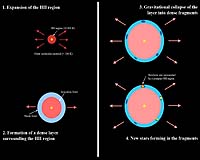
Marseille, France (SPX) Nov 09, 2005 In an upcoming issue, the journal Astronomy & Astrophysics will publish the most complete picture of a "triggered" star-forming region. Induced (or "triggered") star formation is one of the processes that are supposed to lead to the formation of massive stars. Massive stars play a key role in the chemical and dynamical evolution of galaxies. The way massive stars form is still much debated among the astronomers' community: it is currently one of the hottest astrophysical topics. Do they form by accretion as low-mass stars do or do they need the environment of a dense cluster to form through the merging of low mass protostars? In this framework, the team led by Annie Zavagno and Lise Deharveng (from the Laboratoire d'Astrophysique de Marseille, France) selected regions where several generations of massive stars are likely to be formed. Stars more massive than 8 solar masses, once formed, emit intense UV photons that ionize the surrounding gas. The region filled with ionized hydrogen is called an HII region. Theory suggests that the expansion of the HII region can trigger massive star formation: after the HII region has formed, it expands continuously because the temperature inside the region is much higher than in the cold environment that surrounds it. During the expansion, a dense layer of gas and dust is collected around the HII region, after which gravitational instabilities in the layer cause it to fragment into dense clumps, which then go on to collapse into new stars. The fragments are massive and thus form massive objects (stars or clusters). The successive steps of this process, called collect and collapse process, are shown in Figure 1. To characterize this process, the team selected the Galactic HII region RCW 79, located 14000 light-years from the Earth. They combined observational data obtained at different wavelengths, as well as from various origins (space, ground-based telescopes, and archived observations), to probe different parts of the region, as illustrated in Figure 2. The orange image was obtained in the infrared range with NASA's Spitzer Space Telescope: it depicts with high precision the dust shell that surrounds the HII region RCW 79. The blue part of the image corresponds to the H� emission line that probes the ionized hydrogen (observations from the SuperCOSMOS Sky Survey): clearly, the shell is filled in by ionized hydrogen. The team then obtained their own set of observations to elucidate the complete picture of the star-forming region. The yellow contours correspond to observations obtained at millimeter wavelengths with the ESO Swedish Submillimetre Telescope (SEST). These contours depict cold dust condensations in the shell structure. The team has identified the newly-formed stars associated with these condensations, using mid-infrared Spitzer observations from the GLIMPSE survey. They find that second-generation massive stars (with mass higher than 8 solar masses) are associated with the main condensations. One of these condensations was observed at near-infrared wavelengths with the ESO-New Technology Telescope (see insert in Figure 2). It includes a massive star that is evolved enough to emit high-energy photons and to give rise to a compact HII region. This compact HII region is thus a second-generation HII region. The locations of all the structures that were picked out at various wavelengths agree very well with the predictions of the collect and collapse process. The conclusions drawn by the team largely rely on the morphological relations between these structures. The combined picture of RCW 79 they obtained is therefore a straightforward illustration of the triggered massive-star formation process that now occurs in this region. These observations show that the collect and collapse process is the main triggering agent of massive star formation observed on the borders of this region. Community Email This Article Comment On This Article Related Links SpaceDaily Search SpaceDaily Subscribe To SpaceDaily Express Stellar Chemistry, The Universe And All Within It
 Sloan Survey Identifies New Dwarf Galaxy Inside Milky Way
 Washington DC (SPX) Jan 10, 2006
Astronomers using the Sloan Digital Sky Survey have discovered a previously unknown cluster of stars within the Milky Way that appears to be a separate dwarf galaxy being consumed by its much larger neighbor. |
|
|

| The content herein, unless otherwise known to be public domain, are Copyright 1995-2006 - SpaceDaily.AFP and UPI Wire Stories are copyright Agence France-Presse and United Press International. ESA PortalReports are copyright European Space Agency. All NASA sourced material is public domain. Additionalcopyrights may apply in whole or part to other bona fide parties. Advertising does not imply endorsement,agreement or approval of any opinions, statements or information provided by SpaceDaily on any Web page published or hosted by SpaceDaily. Privacy Statement |