|
 |
 |
 |
 |
 |
 |
 |
 |

 |
How Did Cactuses Evolve
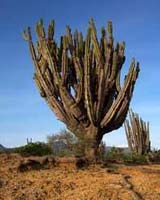
Chicago IL (SPX) May 15, 2006 In a groundbreaking new study in the June issue of American Naturalist, Erika J. Edwards (Yale University and University of California, Santa Barbara) and Michael J. Donoghue (Yale University) explore how leafy, "normal" plants evolved into the leafless succulent cactus. "The cactus form is often heralded as a striking example of the tight relationship between form and function in plants," write the authors. "A succulent, long-lived photosynthetic system allows cacti to survive periods of extreme drought while maintaining well-hydrated tissues." Recent molecular phylogenetic work has confirmed that Pereskia, a genus that consists of 17 species of leafy shrubs and trees, is where the earliest cactus lineages began. Using field studies and environmental modeling, Edwards and Donoghue found that the Pereskia species already showed water use patterns that are similar to the leafless, stem-succulent cacti. "[Our] analyses suggest that several key elements of cactus ecological function were established prior to the evolution of the cactus life form," explain the authors. "Such a sequence may be common in evolution, but it has rarely been documented as few studies have incorporated physiological, ecological, anatomical, and phylogenetic data." Community Email This Article Comment On This Article Related Links University of Chicago Darwin Today At TerraDaily.com
 Farmers And Animals Join Protest Against Bears In France
 Bagneres-De-Bigorre, France, (AFP) May 13, 2006
 Accompanied by donkeys, cows and sheep, some 5,000 people marched in this southwestern French town Saturday in protest against the release of brown bears into the nearby Pyrenees mountains. |
|
|

| The content herein, unless otherwise known to be public domain, are Copyright 1995-2006 - SpaceDaily.AFP and UPI Wire Stories are copyright Agence France-Presse and United Press International. ESA PortalReports are copyright European Space Agency. All NASA sourced material is public domain. Additionalcopyrights may apply in whole or part to other bona fide parties. Advertising does not imply endorsement,agreement or approval of any opinions, statements or information provided by SpaceDaily on any Web page published or hosted by SpaceDaily. Privacy Statement |