|
 |
 |
 |
 |
 |
 |
 |
 |

 |
How Dangerous Are Martians Organisms
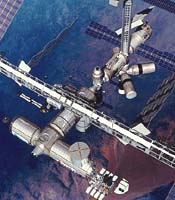
Cameron Park - December 2, 1999 - by Bruce Moomaw Cameron Park - December 2, 1999 - One obvious suggestion is not to recover the returning Mars sample return capsule by parachuting it directly to the Utah desert, but instead to brake it into Earth orbit and make preliminary studies of it on a lab that is attached to the International Space Station -- sending it to Earth only after those studies have indicated either that there are no still-living organisms on it, or that those organisms are not dangerous. This idea was studied in detail by NASA back in 1981 under the name "Project Antaeus" (after the evil giant whom Hercules killed by strangling him while holding his feet off the ground so that he couldn't draw new strength by touching the earth), and it is DiGregorio's choice. But it has problems, as many analysts have pointed out -- including DeVincenzi, the lead author of the Project Antaeus report. The main problem, of course, is simply the added cost -- constructing an entire new module of the Space Station as a facility to carry out complex quarantine and biological test procedures would be very expensive. But there are others. For one thing, there would be no hope of conducting more than relatively superficial tests on Mars samples in such a small facility to detect any dangers -- it would obviously be impossible to check out Martian microbes for more than a very tiny fraction of the ecological problems they could conceivably cause on Earth, and even studies to see if they might cause a human disease would have to be very cursory. Moreover, if some sign of danger did turn up, we would be left with the task of trying to make sure the contaminated lab module (and probably the entire Space Station) never reentered Earth's atmosphere with its dangerous passengers -- and that would be very expensive indeed; we'd have to regularly reboost it back into higher Earth orbit for an indefinite period. It can still be argued, though, that even a very cursory initial inspection of returned Martian samples on the Station for any obvious signs of danger might be worthwhile -- and if such signs did turn up, we would then (as Dr. Levin points out) be free to decide whether the danger was great enough for it to be worthwhile going to the expense of keeping the Station permanently in orbit, or not. There's no doubt, though, that Earth-based facilities could conduct a tremendously more thorough examination of Martian samples both for any biological dangers, and for scientific purposes. And we already have a large number of facilities -- both in the U.S. and elsewhere -- which are routinely used today to contain germs which we know for a certainty are extremely dangerous either to humans (such as the Ebola and Marburg viruses) or to other important species on this planet. The Centers for Disease Control, to name just one example, do exactly this in major cities without setting off a public panic. Any one such facility could be expanded to store and scientifically study returned extraterrestrial samples without prohibitive expense. It seems to me -- as to DiGregorio -- that the point in the whole process of returning and analyzing Mars samples that we should worry about the most is the actual landing of the sample return capsule on Earth.
Murphy's Law It is extremely easy to visualize the possibility that returning capsules containing Martian samples might enter the atmosphere incorrectly, partially burn up, rupture and release their cargo; or that they could crash as a result of parachute failure; or that they could simply be lost in the ocean or somewhere else where they could eventually corrode open and release their contents. All these things have happened many times before during the Space Age. Once the capsule is actually picked up by a recovery team, the main danger of a Mars sample return mission is over. For this reason, I wonder about a possible intermediate course of action. If the sample return capsule is braked into a moderately high Earth orbit by a retrorocket (say, 500 kilometers up), it would be a long time before there would be any danger of its reentering the Earth's atmosphere naturally -- more than enough time to launch a Space Shuttle to rendezvous with the capsule in orbit, retrieve it and load it into a heavy armored cask in the Shuttle cargo bay which could be durable enough to survive virtually any accident the Shuttle might suffer during its landing attempt. Such a cask, even at its heaviest, would still make up only a very small part of the Shuttle's total payload weight; and the same Shuttle mission that carried it could carry out a good many other assignments in orbit first, thus tremendously cutting down on the cost of the retrieval operation itself. And even if such a Shuttle retrieval mission were substantially delayed (as we have now become used to on Shuttles), the sample return capsule could be relied on to wait in orbit for years. The main problem with this scheme would be the mass of the retrorocket needed to slow down the returning capsule by 12 to 14,000 km per hour as it returned to Earth in order to insert it into low Earth orbit -- but such a retrorocket would weight only about twice as much as the weight of the actual orbiting sample return container. And, as compensation, the container would not need a heat shield, a parachute or any shock-absorbing material -- it could be almost as lightweight as the tiny thin-walled container which the currently planned Mars sample return mission is supposed to inject into low orbit around Mars for rendezvous and pickup by a separate Mars orbiting spacecraft. Its only additional requirement would be a solar-powered radio tracking beacon (if that). I think that this idea might, for a quite small additional cost, provide a considerable additional element of safety to the Mars sample return mission. And it would certainly be greatly reassuring to the public -- which, I uneasily suspect, will soon raise unholy hell when it finally sinks into the public consciousness that NASA intends to drop a can of Mars soil into the Utah desert in less than nine years, and to continue doing so at four-year intervals. Just imagine what the tabloids (or Congress) will do with that fact! If NASA wishes to avoid a legal and public-relations nightmare, it may well be worthwhile for it to go to a bit of added engineering expense right now to make this solution possible -- and it seems to me that it is the solution which is most proportionate to the possible impact of any actual danger from extraterrestrial sample returns from possibly habitable alien worlds.
In-situ Saves The Day Viking biology team director Harold Klein thinks the same thing for different reasons; although he thinks unlikely that such microbes exist (at least in Mars' upper soil layers), or that they are likely to be harmful if they do exist, he thinks that the negative results he expects from such tests would greatly simplify NASA's future procedures for sample return and handling (and thus reduce their cost). I think there is a good case to be made that NASA, for publicity reasons, is indeed rushing too quickly into Mars sample return -- especially since there are other arguments that can be made for this. (Planetologist John F. Kerridge, for one, thinks that the chance of returning Mars samples with meaningful fossil evidence of ancient life during the first few sample-return missions is very small -- and that, since such missions are very expensive and there are likely to be only a few of them for some time to come, we should first carry out a considerably more detailed survey of the planet to locate those areas, and mineral deposits, that are the most likely to contain biological evidence.) It is a fact that NASA actually does plan to carry some in-situ experiments on the 2003 and 2005 sample return landers to check the local surface for chemical evidence of life in addition to returning samples from that area to Earth -- and it might very well make more sense for such in-situ experiments to be carried instead on several preliminary landers (as well as surveying Mars' surface more thoroughly with landers, and perhaps with small balloons or airplanes) before we take the major and very expensive leap of returning any samples from it. Mars Invades Earth - Part One - Part Two - Part Three Community Email This Article Comment On This Article Related Links Space
 Satellite Launch To Boost DTH In India
 Calcutta, India (SPX) Dec 28, 2005
The successful launch Thursday of India's heaviest satellite from spaceport of Kourou in French Guyana may have boosted the country's space research efforts to yet another level, but it has also lifted the spirits of at least three Direct-To-Home televisions broadcasters, one of which has been waiting for years to launch its services in India. |
|
|

|
|
|
|
|
|
|
|
|
|
|
|
| The content herein, unless otherwise known to be public domain, are Copyright 1995-2006 - SpaceDaily.AFP and UPI Wire Stories are copyright Agence France-Presse and United Press International. ESA PortalReports are copyright European Space Agency. All NASA sourced material is public domain. Additionalcopyrights may apply in whole or part to other bona fide parties. Advertising does not imply endorsement,agreement or approval of any opinions, statements or information provided by SpaceDaily on any Web page published or hosted by SpaceDaily. Privacy Statement |