
 |
 |
 |
 |
 |
 |
 |
 |
 |

 |
How Corals Adapt To Day And Night
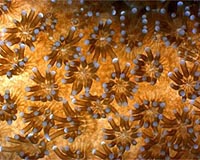
Washington DC (SPX) Sep 17, 2008 Researchers have uncovered a gene in corals that responds to day/night cycles, which provides some tantalizing clues into how symbiotic corals work together with their plankton partners. Corals are fascinating animals that form the largest biological constructions in the world, sprawling coral reefs that cover less than 0.2 % of the seafloor yet provide habitats for more than 30% of marine life. In shallow waters that don't have abundant food, corals have developed a close relationship with small photosynthetic critters called dinoflagellates. The dinoflagellates use sunlight to produce energy for the coral, which in turn use that energy to construct mineralized skeletons for protection. The mineral production, known as coral calcification, is closely tied with the day/night cycle, though the molecular mechanism behind this synchronization is mysterious. Aurelie Moya and colleagues have now characterized the first coral gene that responds to the light cycle; this gene, called STPCA, makes an enzyme that converts carbon dioxide to bicarbonate (baking soda) and is twice as active at night compared to daytime. The researchers found that the enzyme concentrates in the watery layer right under the calcified skeleton, which combined with studies showing that STPCA inhibitors lower calcification rates, confirms a direct role for STPCA in this process. Moya and colleagues propose that STPCA becomes more active at night to cope with acid buildup. The calcification process requires many hydrogen atoms, which during the day can be removed by photosynthesis; at night, however, hydrogen accumulates which increases the acidity of the coral, and therefore STPCA creates extra bicarbonate as a buffer to prevent acid damage. Community Email This Article Comment On This Article Share This Article With Planet Earth
Related Links American Society for Biochemistry and Molecular Biology Darwin Today At TerraDaily.com
 Luck Gave Dinosaurs An Edge
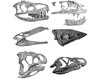 Washington DC (SPX) Sep 17, 2008
T. rex and Triceratops: In the popular imagination, dinosaurs are extraordinary reptiles that ruled the world for over 160 million years. But Steve Brusatte, a doctoral student at Columbia University who is an affiliate of the American Museum of Natural History, and colleagues are challenging this idea with new fossil data and math. |
|
|

| The content herein, unless otherwise known to be public domain, are Copyright 1995-2007 - SpaceDaily.AFP and UPI Wire Stories are copyright Agence France-Presse and United Press International. ESA Portal Reports are copyright European Space Agency. All NASA sourced material is public domain. Additional copyrights may apply in whole or part to other bona fide parties. Advertising does not imply endorsement,agreement or approval of any opinions, statements or information provided by SpaceDaily on any Web page published or hosted by SpaceDaily. Privacy Statement |
 del.icio.us
 Digg
Digg Reddit
 YahooMyWeb
 Google
 Facebook